
Why Is My Water Pressure Weak at Just One Faucet? 6 Culprits
You turn on the kitchen sink, and it blasts like normal, then walk to the bathroom, and the hot side barely dribbles out. Every other tap in the house is fine. That single-fixture pattern is actually good news, because it tells you the problem is small and local. The water arriving at your house is fine. Something between the branch line and the spout of that one fixture is choking the flow.
Quick Answer: When only one faucet is weak, and the rest of the house is strong, the restriction lives at that fixture or the short branch feeding it, not at the main line. The most common cause is a clogged aerator, followed by a worn cartridge, a shutoff valve that is not fully open, a kinked supply line, or scale buildup narrowing the pipe. Most of these can be checked in a few minutes without tools.
How to Read the Pattern First
Before you touch anything, spend thirty seconds gathering two pieces of information. They point you straight at the cause and save you from chasing the wrong part.
First, ask whether the weak flow is on the hot side, the cold side, or both. A fixture that is weak on both hot and cold usually has a common restriction: the aerator at the spout, the cartridge inside the valve body, or a shutoff valve that feeds the whole fixture. A fixture that is weak on only one temperature has a restriction on that specific supply line, which narrows the list considerably.
Second, confirm that it really is just this one fixture. Walk around and run a few other faucets, a tub, and an outside spigot. If they all deliver strong flow and only this one lags, you are dealing with a local problem, and this article covers it. If several fixtures or the whole house feel weak at once, that is a different animal entirely, and the section near the end explains why.
Think of your plumbing like a tree. The main line is the trunk, the branches split off to feed each room, and each fixture is a leaf at the tip. When one leaf wilts while the rest of the tree is green, you do not treat the trunk. You look at that one twig.
The Aerator: Start Here Almost Every Time
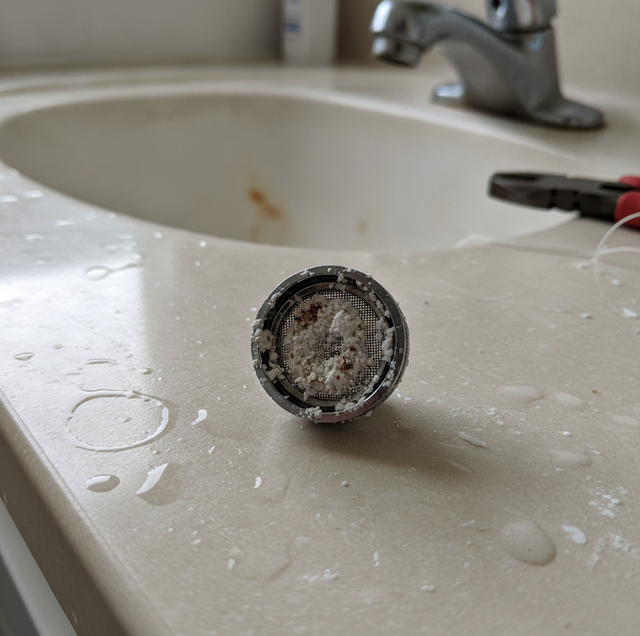
The aerator is the small screened cap threaded onto the tip of most faucet spouts. It mixes air into the stream so the water feels full without wasting volume. It is also the finest filter in the whole system, which means it catches everything: mineral flakes, sand, tiny bits of pipe scale, and the white crust that hard water leaves behind. Over months, the debris packs into the mesh, and the flow drops off.
To check it, unscrew the aerator by hand or with a rag wrapped around it to avoid scratching the finish. Turn the faucet on gently with the aerator removed. If the flow is suddenly strong, you have found your culprit. Rinse the screen, and if it is caked with white deposits, drop it in a cup of white vinegar for an hour to dissolve the scale, then scrub it with an old toothbrush. If the screen is torn or the deposits will not clear, a replacement aerator is inexpensive and threads right back on. This single step resolves a large share of complaints about single fixtures.
When the Cartridge or Valve Is the Restriction
If cleaning the aerator does not restore the flow, the next suspect is inside the faucet body. Modern faucets use a cartridge, a replaceable insert that controls how much hot and cold water passes and mixes. Grit that slips past worn seals or scale forming on the cartridge itself can partially block the internal passages. The result is a weak flow that no amount of aerator cleaning fixes, sometimes on just one temperature, if that side of the cartridge is the one fouled.
Cartridges are faucet-specific, and getting the right replacement means matching the brand and model. This is where many homeowners hand it off to a plumber, both to identify the correct part and to reseat everything without introducing a leak. It is a common repair and not a large one, but it is a step up from cleaning a screen.
The Little Valve Under the Sink
Under most sinks and behind most toilets sit angle-stop shutoff valves, the small handles that let you cut water to that one fixture without shutting off the house. They are easy to overlook, and they cause more single-fixture pressure complaints than people expect.
Two things go wrong. Someone may have closed the valve partway during a past repair and never opened it fully, which throttles the flow every day afterward. Or the valve has corroded internally and no longer opens all the way, even when the handle is turned. Reach under and confirm the valve is turned fully counterclockwise to the open position. If it feels stiff, crusty, or will not budge, do not force it, because an old valve can snap. A stuck or corroded stop is a simple valve replacement for a plumber.
Supply Lines, Showerheads, and Scale
A few more local restrictions round out the list. The flexible supply lines that connect the shutoff valve to the faucet can kink where they bend behind the cabinet or collect debris at the inlet screen, reducing the flow. Pull the cabinet contents out and look at how the lines run; a sharp kink is easy to spot and easy to relieve.
For showers, the showerhead is the aerator's equivalent. Its spray nozzles lime up with hard-water deposits until the pattern goes weak and uneven. Unscrew it and soak it in vinegar the same way, or tie a vinegar-filled bag around it overnight if it is awkward to remove.
Then there is a scale inside the branch pipe itself. In hard-water areas, calcium and magnesium slowly plate the inside walls of the pipe, and over the years, the effective diameter of a branch can shrink noticeably. This shows up as a fixture that has gotten gradually weaker with no single trigger, and it is the one cause on this list that a homeowner cannot clear from the spout end. Restoring a scaled branch is pipe work, and it is worth pairing with a conversation about water treatment so the buildup does not simply return.
Local Fixture Versus the Whole House
Everything above assumes one weak fixture in an otherwise strong house. If your walk-around test instead showed weak flow at several fixtures or across the entire home, stop looking at aerators and cartridges. Whole-house weakness points upstream: a failing pressure-reducing valve where the line enters the house, a partially closed main shutoff, a problem at the meter, or a supply issue from the utility. Those are diagnosed and repaired at the source, not at the sink, and they are a separate job from the local fixes here. The one-fixture test is the fork in the road. It decides which of the two problems you actually have.
Homeowner Fixes Versus Calling a Pro
You can safely handle the top of the list yourself. Clean or replace an aerator, confirm the shutoff valve is fully open, straighten a kinked supply line, and soak a limed showerhead in vinegar. Before you remove any part that holds water, close that fixture's shutoff valve first and open the faucet to relieve pressure, so you are not fighting a live line.
Call a plumber for the deeper items: a cartridge or mixing valve replacement, a corroded shutoff that needs swapping, or scale that has narrowed the branch pipe. These need the right parts and the confidence to reassemble without a leak, and they are exactly the kind of small, contained repair a plumber knocks out quickly.
Frequently Asked Questions
The aerator, but how you get it off matters. Many aerators can be unthreaded by hand once you get a grip, while a recessed "cache" aerator sits flush in the spout and requires the small key tool that shipped with the faucet to back it out. If a replacement is needed, note that aerators come in different thread sizes and male or female fittings, so the new one has to match that faucet rather than being a universal part. Get the right one, and it threads back on and restores flow in minutes.
Scale forms faster in hot water, so the hot side of a system limes up sooner than the cold. On top of that, the water heater and the threaded nipples at its inlet and outlet add their own restriction to the hot path. When the cold runs strong at a fixture but the hot barely trickles, the choke point is almost always somewhere in that hot branch or on the heater side, rather than in the faucet you are standing at.
It depends on which type of stop you have. A quarter-turn ball stop, the kind with a lever that moves ninety degrees, is either fully open or fully shut and rarely the cause of partial weakness. An older multi-turn compression stop, with a round handle you spin several times, is the one to suspect, because it can be left cracked only partway or corrode internally around the washer. Either fault throttles just that one fixture while the rest of the house stays fine, so identify the handle style first, then confirm it is wide open.
Put a number on it with a gauge. Normal residential static pressure runs about 40 to 60 psi, and a cheap threaded gauge on an outside hose bib reads it in seconds. If the gauge sits in that range but one fixture still trickles, the house supply is fine, and the problem is that fixture or its branch. If the gauge itself reads low across the whole home, the cause sits upstream at the main line, the pressure-reducing valve, or the utility, which is a completely different repair made at the source instead of at the sink.
Any work on the line, a repair, a shutoff, even flushing the water heater, can knock loose sediment or flakes of scale that then travel with the water and lodge in the first tight spot they reach. That is usually the nearest aerator, cartridge, or valve screen. A fixture that weakens the day after a repair often just needs its aerator or inlet screen cleared of debris, the work stirred up.
A shower adds two parts the sink does not have: the showerhead itself and, on many valves, a pressure-balancing or mixing cartridge behind the wall. So weak shower flow splits into an easy cause and a harder one. A limed-up showerhead clears with a vinegar soak, while a failing balancing or mixing valve is a pro repair inside the wall. Running the sinks nearby tells you whether the shower alone is affected, which points you toward the head-and-valve list rather than a house-wide issue.
Have a plumber pinpoint and clear that one stubborn fixture — so every tap in the house runs strong again. MNS Plumbing & Drain Cleaning serves Anthem and the Valley. ROC 262137. Call (602) 362-4524.
