
Whole-Home vs Plug-In Surge Protector: Do You Need Both?
Quick Answer: A whole-home surge protective device mounts at the electrical panel and knocks down large surges before they spread through the wiring. A plug-in strip guards a single device from the smaller leftover energy and from surges made inside the home. They protect against different threats, so the reliable setup uses both, not one instead of the other.
What Actually Causes a Surge
A surge is a brief spike in voltage that rides your wiring for a fraction of a second. Normal household voltage sits around 120 volts on a standard circuit. A surge can push that far higher for a few millionths to a few thousandths of a second, and it is that overshoot, not the duration, that stresses insulation and semiconductors.
Surges come from more than one source, and the sources do not follow a calendar.
Outside The Home: Lightning is the dramatic one. A strike does not have to hit your roof to matter; a hit on a nearby line or even the ground can couple energy onto the utility feed and send it toward your panel. Lightning is more frequent in warmer, stormy months in many regions, but the utility side produces surges the rest of the year too. When the power company switches equipment, restores power after an outage, or a pole-mounted converter down the street cycles, the grid delivers voltage transients that arrive regardless of the weather.
Inside The Home: Most surges are homegrown and small. Every time a large motor cycles, an air conditioner compressor, a well pump, a refrigerator, a garage door opener, the collapsing magnetic field kicks a little voltage back onto the circuit. These internal surges are minor individually, but they happen dozens of times a day, year round, and the cumulative wear on electronics is real.
How A Whole-Home Device Works
A whole-home unit, often called a service-entrance surge protective device, is wired into the electrical panel where power enters the house. Because it sits at the panel, it sees surges before they branch out to individual circuits, and it protects every outlet, switch, and hardwired appliance downstream at once.
Inside the device are components, commonly metal oxide varistors, that behave like a pressure-relief valve for voltage. At normal voltage they do nothing and simply sit in the circuit. The instant voltage climbs past a set threshold, their resistance drops sharply and they divert the excess energy to the ground and neutral, clamping the voltage back down to a safer level. This all happens in nanoseconds.
Panel-mounted units are graded by where they are meant to sit. A Type 1 device is rated to install on the line side, ahead of the main breaker, and is built to take the largest incoming hits. A Type 2 device installs on the load side, after the main breaker, and is the more common residential choice. Both handle the heavy lifting of a large external surge.
A whole-home device carries lethal voltage on its connections because it lands directly in the panel. Installation is not a homeowner job. It must be wired in by a licensed electrician, and the panel should stay closed and untouched by anyone without the training to work inside it.
WARNING: A whole-home surge device lands directly in the electrical panel, where the connections carry lethal voltage even with the breakers off. Installing one is not a homeowner job. It must be wired in by a licensed electrician, and the panel should stay closed and untouched by anyone without the training to work inside it.
How A Plug-In Strip Works
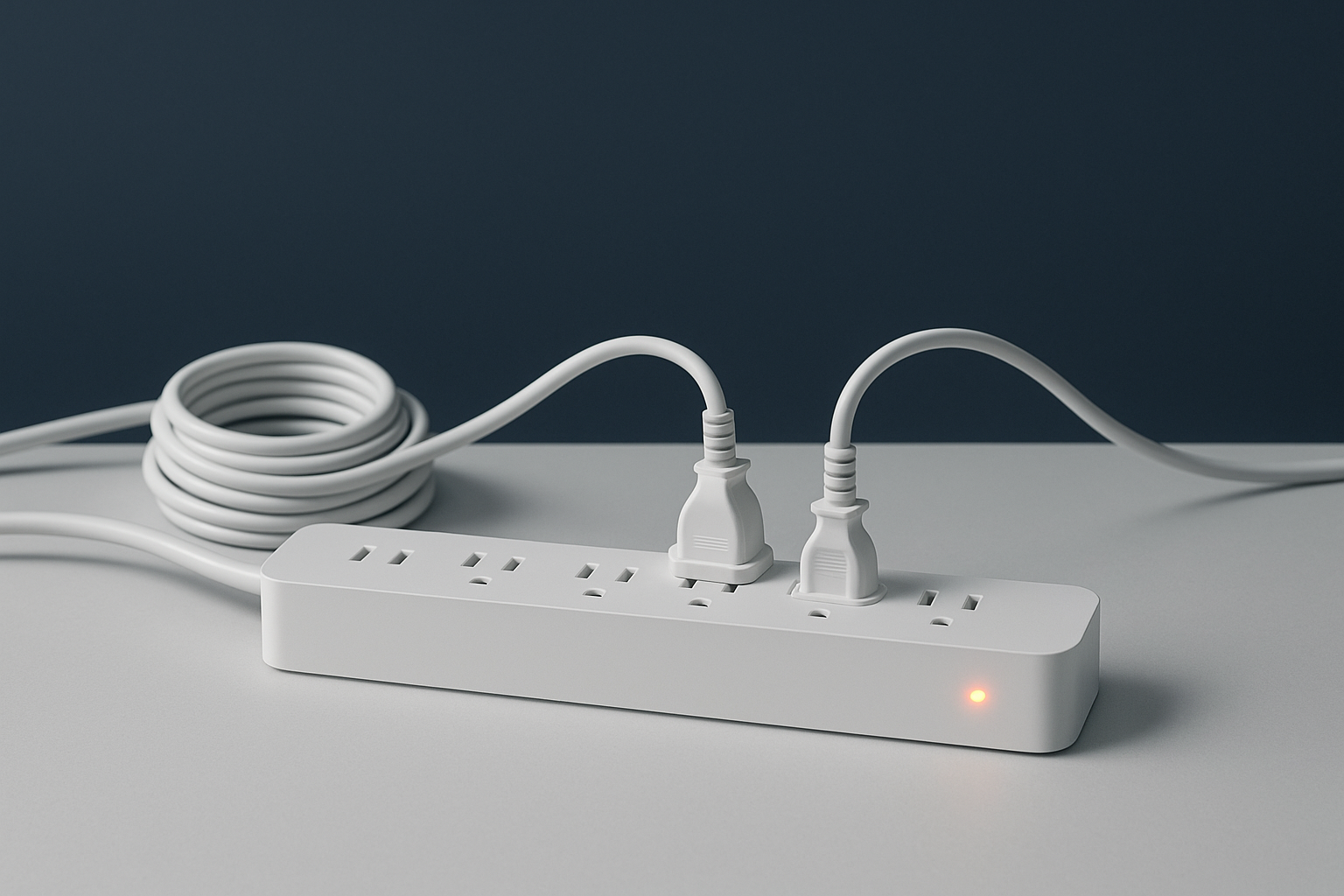
A plug-in surge protector, also called a point-of-use device, is the strip or wall tap you plug a television or computer into. It uses the same varistor principle, but it works at much smaller scale and right at the equipment it serves.
Two jobs make the plug-in strip worth having even after a panel device is installed. First, a whole-home unit does not clamp voltage all the way down to zero overshoot; it lets a smaller residual through, and the strip cleans up that leftover energy at the outlet. Second, the strip is the only layer positioned to catch surges generated inside the home, the ones from motors and appliances that are born downstream of the panel and never pass the service-entrance device at all.
A plug-in strip is homeowner-safe. It plugs into a standard outlet, no tools and no panel access required.
Reading Joules And Clamping Without The Jargon
Two numbers show up on plug-in packaging. The joule rating is the total energy the device can absorb over its life before it wears out. Think of it as a fuel tank that drains a little with each surge it eats and does not refill. A higher joule rating means a longer working life and more headroom for a big hit.
The clamping voltage, sometimes listed as a suppressed voltage rating, is the level at which the device starts diverting energy. A lower clamping voltage means it steps in sooner and lets less overshoot reach your gear. The two numbers work together: you want a device that acts early and has enough capacity to keep acting for years.
Why The Two Layers Complement Each Other
The layered approach is the standard for a reason, and the cleanest way to see it is the analogy of a building's plumbing. A pressure-reducing valve at the water main tames the high street pressure for the entire house, but you still want an aerator on the kitchen faucet to smooth the flow right where you use it. Neither replaces the other, because they solve the problem at different points in the system.
Surge protection maps onto that exactly. The panel device is the main-line valve that handles the big pressure from outside. The plug-in strip is the faucet-level device that handles what is left plus what the house makes on its own. A home with only a panel unit still exposes sensitive electronics to internally generated surges and to residual let-through. A home with only strips leaves the whole structure, and every hardwired appliance without a strip, unprotected from a large external event. Sensitive electronics, anything with a delicate circuit board and stored data, benefit most from having both layers between them and the wiring.
What A Surge Protector Does Not Do
A surge protector is not a cure-all, and two limits matter.
It does not replace proper grounding. A surge device works by shunting excess energy to ground, so it depends on a sound grounding and bonding system already being in place. If the grounding is inadequate, the device has nowhere to send the energy and cannot do its job. A surge protector is an addition to good grounding, never a substitute for it.
It also does not condition power in the way a battery backup does. A surge device clamps voltage spikes, but it does not fill in a sag, ride through a brief outage, or smooth out dirty power. For equipment that cannot tolerate any interruption, an uninterruptible power supply covers a gap the surge protector was never designed to fill.
Signs A Plug-In Strip Is Worn Out: Because the joules deplete with use, a plug-in strip does not last forever, and a worn one can look identical to a healthy one. Watch for these:
- The protection status light has gone dark or switched to a warning color, if the strip has one.
- The strip has been in service for years and has taken a known large surge or a nearby lightning event since.
- Outlets still deliver power but you have no way to confirm the surge components are intact, which is common on cheaper units with no indicator.
A strip that still powers your devices may have already spent its protective capacity. Power at the outlet is not proof the surge protection is alive.
TIP: If your plug-in strip has a protection status light, glance at it now and then. A light that has gone dark or turned to a warning color means the surge components are spent even though the outlets still deliver power, so treat that strip as worn out and replace it.
Frequently Asked Questions
No. Daisy-chaining two strips does not stack their joule ratings, and manufacturers warn against it because the series connection can overload the first strip's wiring and create a heat risk. Plug each strip directly into a wall outlet.
Either can happen. A single very large surge can exhaust a device's capacity in one event, while a run of small surges drains it gradually. Some panel units are built with replaceable modules or a visible indicator so the spent part can be swapped without changing the whole device.
Yes, and that is one of its strengths. Because it sits at the panel and covers everything downstream, it guards hardwired equipment that has no plug and so cannot use a strip, such as the range, the central air handler, and a hardwired dishwasher.
A plain power strip is only a row of outlets on one cord with no protective components inside. It splits one outlet into several and does nothing to stop a surge. A surge protector looks similar but contains the diverting components and carries a joule and clamping-voltage rating, which a basic power strip does not.
They matter for safety and longevity. Better devices pair the varistor with a thermal cutoff that disconnects the component if it overheats near the end of its life, reducing fire risk as the part degrades. Some units add a gas discharge tube to handle very fast, high-energy transients the varistor alone would struggle with.
It can, and it often should. A surge can enter through a cable, satellite, or phone line as easily as through the power cord, so many strips include pass-through jacks for coax and Ethernet. Protecting the power cord but leaving the data line unprotected gives a surge an open back door into the same equipment.
Ask about layered surge protection for your home — one visit sizes the panel device and points you to the right point-of-use setup. Kennedy Electric serves Citrus, Hernando, and Pasco Counties. License #EC13011268. Call (352) 251-2795.
