
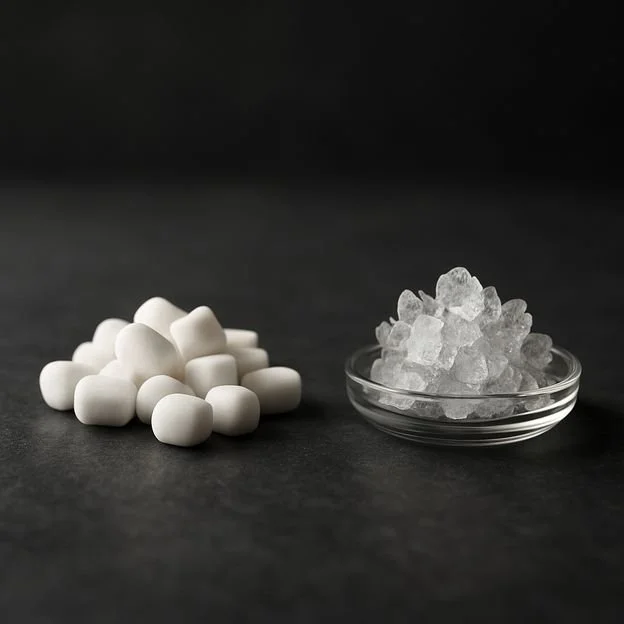
Standing in the water treatment aisle, or scrolling through options after yet another cloudy glass and a crust of white buildup on the faucet, the choice usually comes down to two very different-sounding products: a salt-based softener, or a salt-free conditioner that promises the same scale protection without the bags of salt, the brine discharge, or the slippery feel some people dislike. The marketing on both sides sounds confident. What actually happens inside each system is not the same process at all, and that difference matters more in truly hard water than most of the packaging lets on.
What Hard Water Actually Means
Hardness comes from dissolved calcium and magnesium picked up as water passes through rock and soil before it ever reaches a home. It is measured in grains per gallon, and water utilities across the region commonly report readings in the very hard to extremely hard classification, well above the point where scale becomes a fast, visible problem rather than a slow one. Those minerals do not disappear on their own. They ride along in the water until something, evaporation on a fixture, heat inside a water heater, or simple time, gives them a chance to come out of solution and bond to a surface.
How a Salt-Based Softener Actually Removes Hardness
A salt-based softener uses ion exchange. Resin beads inside the tank hold sodium ions, and as hard water flows through, the beads trade sodium for the calcium and magnesium riding in the water. The hardness minerals stay on the resin until a regeneration cycle flushes them out with a strong brine solution pulled from the salt tank, sending the calcium, magnesium, and used brine down the drain and recharging the resin with fresh sodium. Water leaving the tank is measurably softer: the minerals are physically gone, not just altered, which is why a salt-based system is the only one of the two that changes the actual hardness number on a water test.
How a Salt-Free Conditioner Works Instead
A salt-free conditioner takes a different approach entirely, most commonly using a media technology called template-assisted crystallization. Rather than pulling calcium and magnesium out of the water, the media encourages those minerals to form microscopic crystals as water passes through. Those crystals stay suspended in the water instead of bonding to pipe walls, fixture surfaces, or heating elements, so the water still tests just as hard afterward, the minerals never left, but the minerals are far less likely to stick anywhere and build up as scale. No salt, no brine tank, and no discharge to the drain, since nothing is being flushed out.
Comparing the Two Directly
| Salt-Based Softener | Salt-Free Conditioner | |
|---|---|---|
| What it does to hardness | Removes calcium and magnesium from the water | Leaves the minerals in the water, alters their crystal form |
| Water tests soft afterward | Yes | No, still reads hard on a test |
| Adds sodium to the water | Yes | No |
| Ongoing salt/maintenance | Regular salt refills, periodic regeneration | No salt; media has its own replacement schedule |
| Water discharged to a drain | Yes, during regeneration | No |
| Soap lather and the "slippery" feel | Present, minerals are actually gone | Reduced compared to true softening |
| Effectiveness in very hard water at high flow | Consistent regardless of demand | Can be overwhelmed past the media's rated capacity |
Where Salt-Free Conditioners Fall Short in Very Hard Water
Template-assisted crystallization media is rated for a specific flow rate and hardness range, the conditions under which it reliably converts nearly all the calcium and magnesium passing through. Push it past that window, a household running several fixtures at once on water at the extreme end of the hardness scale, and some of the incoming minerals pass through without being converted. That untreated fraction behaves exactly like ordinary hard water: it still scales a water heater element, still leaves spotting on glassware, and still builds the white crust people install a system specifically to stop. At the extreme end of the hardness scale, this is the scenario where a salt-free system's real-world performance falls short of a salt-based softener's.
Where Salt-Free Makes Sense Anyway
None of that makes salt-free the wrong choice across the board. A household on a sodium-restricted diet gets a real benefit from a system that adds none, since a salt-based softener does put a small amount of sodium into the water for every hardness ion it removes. Skipping the brine discharge appeals to anyone who wants to avoid sending softened wastewater down the line every regeneration cycle. And day to day, there is no salt to haul and load, and no regeneration schedule to keep tuned, since the media works continuously rather than cycling.
Matching the Media to the Water, Not the Marketing
The right choice comes down to an actual hardness test on the property's own supply compared against a given system's rated capacity, not which box uses the word "eco" more confidently. A salt-based softener is the more certain fix when hardness readings run high and household demand is heavy, since it physically removes the minerals no matter how hard the water gets. A salt-free conditioner is a reasonable fit where hardness is more moderate, sodium is a concern, or the household would rather skip the maintenance, provided the system is sized to the water it is actually facing rather than assumed to handle anything thrown at it.
Frequently Asked Questions
Yes, and it is a reasonable middle path for a household that wants to limit sodium overall but still protect the most heat-sensitive fixture in the house. A common setup runs a salt-free conditioner for the whole house while a smaller point-of-use softening cartridge feeds just the water heater or a tankless unit, giving the appliance most vulnerable to scale a stronger level of protection without softening every gallon used for laundry, bathing, and irrigation.
Skipping the media replacement is the most common reason a salt-free system that worked well for years suddenly seems to stop protecting fixtures. The crystallization media has a finite service life and needs to be swapped on its own schedule once it stops converting minerals effectively, a different kind of upkeep than loading salt but not the maintenance-free arrangement some marketing implies.
Not necessarily to the same degree. Tankless units are especially sensitive to scale because water passes through narrow heat-exchanger passages, and manufacturers of tankless equipment often specify a maximum hardness level or require some form of treatment before their warranty stays valid without extra conditions. Checking the specific unit's documentation matters here, since a conditioner that performs fine on fixtures and appliances generally may still fall short of what a particular tankless model's warranty terms expect.
A water test reports hardness in grains per gallon or an equivalent parts-per-million reading, and testing the property's own supply matters more than relying on a published utility average, since an older neighborhood on a different main or a home fed from a blended source can read meaningfully harder or softer than the citywide figure. Sizing either system off an assumed number rather than an actual test is one of the more common reasons a system underperforms.
It does not add sodium the way a salt-based softener does, so it will not shift taste for that reason, but neither system by itself addresses taste or odor coming from chlorine, other treatment additives, or dissolved minerals unrelated to hardness. Taste and odor concerns are usually handled with a separate filtration step, carbon filtration or reverse osmosis, layered in alongside whichever hardness treatment gets chosen.
Yes, and that is part of why waiting for visible buildup before treating water can already mean damage is underway. Scale forms inside pipes and inside a water heater tank well before it shows up at a faucet aerator or on a fixture, gradually narrowing the inside diameter of lines and insulating heating elements so they draw more energy and wear out sooner. The visible spotting and crust people notice on fixtures is usually a late sign of a process that started somewhere out of sight.
Get your water tested before choosing a system — the right treatment depends on your actual hardness numbers, not a guess. MNS Plumbing & Drain Cleaning serves Anthem and the Valley. ROC 262137. Call (602) 362-4524.
