
What a Single Pinhole Leak Reveals About Your Whole Plumbing System
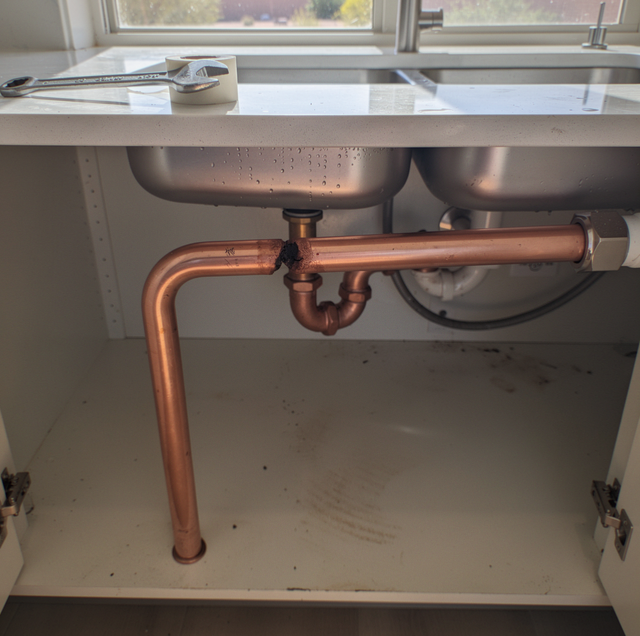
You find a small wet spot on the ceiling or a hairline crack in the slab that keeps getting damp no matter how many times you mop it. A plumber opens the wall or cuts a small access hole, and there it is: a pinhole no bigger than a pencil tip, weeping water under pressure. It gets patched or a short section gets cut out and replaced, and the natural next question is whether that's the end of it or just the first one.
That question matters more than it seems, because a pinhole isn't really a story about one weak spot in a pipe. It's a story about everything that pipe has been exposed to since the day it went in, and in most homes, every section of pipe from that era has been exposed to close to the same thing.
A Pinhole Is a Symptom of Exposure, Not Bad Luck
A pinhole leak forms when a small area of the pipe wall wears through faster than the surrounding metal. In copper, that's almost always a corrosion process working from the inside out: mineral-heavy water, an aggressive pH, dissolved oxygen, or bacterial activity attacks the copper at specific points rather than evenly across the surface. Those points become pits, the pits deepen, and eventually one breaks through.
That process needs three ingredients: a metal that reacts to what flows through it, water chemistry that drives the reaction, and time. None of those three ingredients are unique to one six-inch section of pipe. The water flowing through the pinhole spot is the same water flowing through every other foot of pipe on that line, and the metal usually came from the same supply run, installed on the same day, to the same standard of the era.
So when a pit finally breaks through in one place, it's less like a single flaw and more like the first domino to fall in a row that's been leaning the same way for years. Somewhere else on that same line, the pipe wall may already be thinner than it should be. It just hasn't broken through yet.
Why One Failure Often Isn't Alone
Think of copper pipe like a set of tires bought and mounted together. One tire wearing thin doesn't mean the others are fine just because they haven't gone flat yet. They've carried the same load over the same roads for the same number of miles, so a blowout on one is a reason to check the tread on all four, not just to patch that one and move on.
Pipe works the same way. If your water runs hard and mineral-heavy, or carries a chemistry that's mildly aggressive to copper, that chemistry has been moving through every pipe in the house at roughly the same rate since installation. A section behind a shower wall wears under a slightly different set of conditions- more humidity, more temperature swings- than a section running through an attic or a garage, which is why leaks don't always show up on the same day. Different timing on the same wear isn't the same as an isolated event; it's the same clock, ticking at slightly different speeds in different rooms.
That's the distinction a plumber is working through the moment a pinhole turns up: is this pipe an outlier, or the first section to reach a threshold the rest of the system is approaching too?
What a Plumber Actually Checks Before Deciding Anything
Finding one leak and reaching a conclusion about the whole house would be guesswork. A proper read on the situation comes from a short list of specific checks, not a hunch.
Pipe material and wall type: Copper comes in different wall thicknesses, and some eras and grades are known to pit more readily than others. Identifying what's installed and when it was likely installed sets the baseline for how much life the system should have left.
Where the leak sits: A pinhole at a joint or a spot where the pipe rubs against a stud or strap often points to a local, mechanical cause: abrasion, a bad solder joint, or a stray fastener. A pinhole in the middle of a long, undisturbed run points more toward water chemistry working on the metal itself, a system-wide condition rather than a local accident.
What the pipe wall looks like around the failure: Cutting out the failed section lets a plumber inspect the metal on both sides. Clean copper right up to the edge of the hole suggests a localized event. Pitting or thinning extending outward from the hole suggests the corrosion process is active well beyond that one spot.
A look at other accessible sections: Wherever pipe is already exposed, at a water heater connection, under a sink, in a crawlspace or attic run, a plumber checks it for the same signs: staining, small blisters, or thinning near joints. Consistent wear across multiple unrelated points is the strongest signal that the whole line is on the same trajectory.
Water conditions: Hardness, pH, and mineral content all affect how aggressively water attacks copper. If the water has been hard since day one, every pipe fed by it has been under that same stress the whole time, not just the section that already failed.
The leak's place in the timeline: A first-ever leak in a fifteen-year-old system reads differently than a second or third leak inside a year or two. A pattern of leaks spaced months apart, in different rooms, on the same material, comes close to stating outright that the system is reaching the end of its service life across the board.
When a Spot Repair Is the Right Call
Not every pinhole is a warning about the whole house, and treating every leak as proof of system failure would be its own kind of mistake. A repair to the failed section is the end of the story when a few things line up together.
If the failure sits at a joint or a point of physical contact, a nail through a wall, a strap that's been rubbing the pipe for years, a poorly soldered fitting, and the surrounding pipe looks clean and undamaged, that's a local, mechanical cause with no reason to expect it elsewhere. If the system is relatively young for its material and the water conditions have been managed, treated, or filtered, with moderate hardness- one failure doesn't automatically mean the rest of the line is close behind. A check of other accessible sections turning up no pitting, staining, or thinning adds further weight to a one-off cause.
In that scenario, a clean cutout-and-repair, or replacing the single affected run, resolves the issue without touching anything else.
When One Leak Signals a Whole-House Pattern
The picture changes once the evidence points away from a single cause and toward a shared one. A few situations tend to shift the conversation from repair to a broader plan.
A second or third leak within a short stretch of time, especially on the same material and in different parts of the house, is one of the clearest signals available. So is finding active pitting or thinning in exposed sections that haven't leaked yet, a system showing its condition before it fails outright rather than after. Aggressive water chemistry that's been constant since the home was built is another factor, since every foot of copper has been under the same stress for the same number of years, whether it has broken through yet or not.
Age relative to material matters too. Copper systems can serve a home for decades, but that lifespan assumes reasonably balanced water and standard wall thickness. A system built with thinner-wall pipe, run through unusually hot attic space, or fed by consistently hard, mineral-dense water can reach the failure stage well ahead of that general expectation. When the material, the water conditions, and the age of the system all point the same direction, patching each new pinhole as it appears stops making sense as a strategy. Each new repair chases a symptom while the rest of the line keeps aging on the same schedule, and the next failure is rarely convenient.
Why the Pipe Material Changes the Math
The corrosion pattern behind most pinhole leaks is largely a copper story. PEX doesn't corrode the way metal does, so it isn't prone to the same slow, internal pitting process. When PEX fails, it's typically due to a different cause: a manufacturing defect in a specific batch, UV damage before installation, or a fitting that was never properly seated. Those causes are less likely to be shared uniformly across an entire system, as water chemistry is shared across every foot of copper pipe, though a bad batch can still show up in more than one place.
That difference matters when a home has copper running beneath a slab, which is common on a slab-on-grade foundation. Buried copper sits in constant contact with soil and moisture, an extra layer of chemical stress on top of whatever the water is already doing from the inside. A slab leak in one spot is often a sign that the rest of the buried run has been sitting in the same soil for the same number of years. Where soil conditions make trenching slow, rerouting new pipe overhead or through interior walls is often the more practical path than digging up a slab section by section, and it sidesteps the corrosion-prone soil contact for good.
What Waiting on the Pattern Actually Costs You
Treating every pinhole as an isolated event, when the evidence says otherwise, has a cost measured in disruption more than anything else. Each repair means another cut section of drywall or ceiling and another day without water to that fixture, while the rest of the line keeps aging at the same rate regardless of how many individual leaks get patched.
The bigger risk is where the next leak lands. A pipe that fails behind an accessible wall is an inconvenience. The same pipe failing inside a slab or above a finished ceiling turns a plumbing repair into a far larger project, and there's no way to choose which section goes next once the whole line is at a similar point in its life. Once several pieces of evidence point to a shared cause, a full, section-by-section evaluation of the system gives you an actual picture of what's failing and what's holding, instead of waiting for the next hole to announce itself.
Frequently Asked Questions
There's no fixed number, but a second leak on the same material within a year or two of the first is a strong signal, especially in unrelated parts of the house. What matters more than the count is whether an inspection of other accessible pipe shows the same pitting or thinning pattern. One leak with clean pipe everywhere else is different from two or three leaks plus visible wear at points that haven't failed yet.
Yes, and that's what makes internal corrosion hard to catch early. Pitting starts on the inner wall of the pipe, invisible from the outside, and the metal can look normal right up until it thins enough to break through. That's why a plumber cuts into a failed section to check the surrounding wall thickness, rather than judging its condition by outward appearance alone.
Not directly, but if the rest of the line is already weakened by corrosion, it remains just as vulnerable as before the repair. A single-section repair fixes the spot that failed; it doesn't affect wall thickness anywhere else along the line.
Generally, yes, because PEX doesn't corrode internally the way copper does under mineral-heavy or chemically aggressive water. Its failure points tend to be tied to installation quality, UV exposure before the pipe was installed, or an isolated material defect, rather than to a slow, system-wide process. That's one reason a full or partial reroute to PEX often comes up once a copper system shows a pattern across multiple sections.
Water treatment, such as a softener or a pH-adjusting system, can slow the corrosion process going forward by reducing what's attacking the pipe from the inside. It doesn't reverse damage already done. Pipe that's already pitted or thinned stays that way; treatment mainly protects sections that haven't been significantly affected yet.
The biggest one is the condition of the pipe wall itself, both at the failure point and at other spots that haven't leaked. That requires cutting into or exposing sections of pipe, not something to do casually in a finished home. A plumber also knows what normal wear looks like at a given age and water condition, so a pattern that alarms a homeowner might be ordinary, or the reverse: pipe that looks fine on the surface might already be past the point where a spot repair solves anything.
Get ahead of the next pinhole leak — schedule a full pipe system inspection. MNS Plumbing & Drain Cleaning serves Anthem and the Valley. ROC 262137. Call (602) 362-4524.
