
Expansion Tank vs. Pressure-Reducing Valve: Which You Need
Quick Answer: A pressure-reducing valve lowers high incoming water pressure from the street. A thermal expansion tank absorbs the pressure spike that happens when a closed system heats water. They solve two different problems, and a home with high street pressure and a water heater often needs both.
People tend to lump these two devices together because they both deal with water pressure, and both sit near the parts of the plumbing you never think about until something fails. But a pressure-reducing valve and a thermal expansion tank do opposite jobs. One holds back pressure coming into the house. The other makes room for the pressure the house creates on its own. Knowing which one your home needs, or whether it needs both, comes down to two questions: how hard is the water pushing in from the street, and is your plumbing a closed loop?
What A Pressure-Reducing Valve Actually Does
A pressure-reducing valve, or PRV, is a spring-loaded fitting installed on the main water line where it enters the house, usually just past the shutoff. Municipal supply lines often run at pressures far higher than a home needs. That extra pressure helps the utility push water uphill and out to distant customers, but by the time it reaches your fixtures, it can be more than the plumbing was built to handle.
Most residential fixtures, valves, and appliance inlets are rated for a working range of roughly 50-60 psi. Once static pressure climbs past about 80 psi, it starts stressing everything downstream: faucet cartridges wear out faster, toilet fill valves chatter, washing machine and dishwasher inlet hoses take a constant pounding, and supply lines can eventually fail. A PRV steps down incoming pressure to a set point within the safe range and holds it there, so the house sees a steady, moderate pressure no matter what the street is doing.
The signs that point to a PRV problem are pressure symptoms felt throughout the house, not at one appliance. Banging or hammering pipes when a valve snaps shut, toilets that run or refill on their own, faucets that spit, and outright burst supply lines are the classic tells. The definitive check is a gauge reading: a hose-bib pressure gauge that shows well over 80 psi means either there is no PRV or the one you have has failed.
What A Thermal Expansion Tank Actually Does
Here is where the two devices connect. A PRV, along with backflow preventers and check valves that a water meter or utility may install, allows water to flow in only one direction: into the house. That is good for preventing household water from siphoning back into the public supply, but it turns your plumbing into a closed system. Water can come in, but it cannot push back out toward the street.
That matters because of a basic fact of physics: water expands when it is heated. When your water heater fires up and warms a tank of water, the water expands in volume. In an open system, the extra volume simply nudges back toward the main, and the pressure barely moves. In a closed system, the expanding water has nowhere to go. Pressure spikes hard and fast every time the heater runs, and there is nothing to relieve it except the water heater's temperature and pressure relief valve, the T&P valve, which is a last-resort safety device, not a pressure regulator.
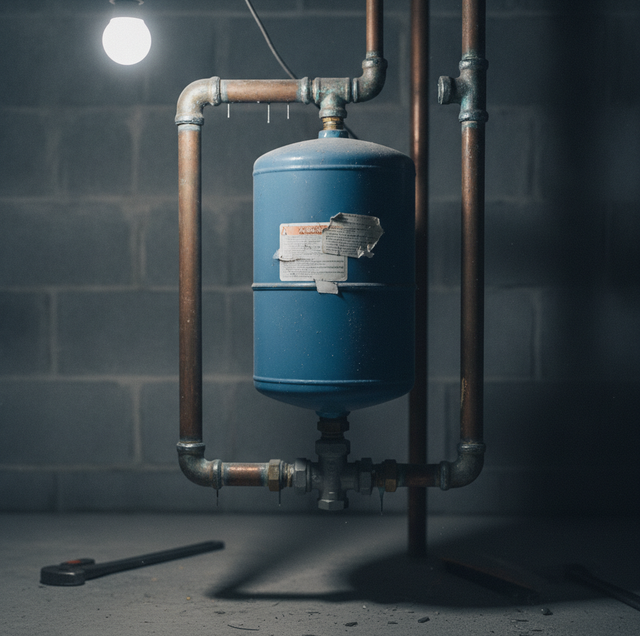
A thermal expansion tank solves exactly this. It is a small steel tank, plumbed into the cold-water line feeding the water heater, divided inside by a rubber bladder. One side holds water; the other holds a cushion of pressurized air. Think of it like the crumple zone on a car: when expanding water pushes in, the air cushion compresses and absorbs the surge instead of letting it slam into the T&P valve and the rest of the plumbing. When water is drawn and pressure drops, the air pushes the water back out, and the bladder resets.
The symptoms of a missing or failed expansion tank differ from those of a PRV and cluster around the water heater. The most common is a T&P valve that drips or discharges, especially in the hour or two after a hot-water draw. Another is pressure that reads normal at rest but creeps up only after the heater has run through a heating cycle. Water hammer or a knocking sound near the heater is a third. If your gauge is fine at a cold hose bib but the relief valve keeps weeping, thermal expansion in a closed system is the usual cause.
How To Decide Which One You Need
The decision follows from those two questions, and the table below lays out the split.
| Pressure-Reducing Valve | Thermal Expansion Tank | |
|---|---|---|
| What it does | Lowers high incoming street pressure to a safe range | Absorbs the pressure spike created when heated water expands |
| Where it mounts | On the main line where water enters the house | On the cold-water line feeding the water heater |
| Symptom it fixes | Banging pipes, running toilets, burst supply lines, >80 psi at the gauge | Dripping T&P valve, pressure creeping up after the heater runs, hammer at the heater |
| When you need it | Incoming street pressure is too high | Home is a closed system and has a water heater |
Put simply: if a gauge shows your incoming pressure running high, you need a PRV to bring it down. If your home is a closed system, meaning it has a PRV, a backflow preventer, or a check valve somewhere between the meter and the house, and it has a tank water heater, you need an expansion tank to handle thermal expansion. Many homes tick both boxes because installing a PRV is one of the things that creates the closed system in the first place. That is why a home can get a new PRV and then, weeks later, develop a dripping relief valve it never had before: the pressure problem was solved, but the closed-system side effect went unaddressed.
The first step in sorting this out is cheap and worth doing before anything else. Thread an inexpensive water-pressure gauge onto an outdoor hose bib, fully open the valve, and read the static pressure. A reading above roughly 80 psi points toward a PRV. A normal cold reading, combined with relief-valve dripping, points toward thermal expansion and an expansion tank. If both symptoms are present, both devices are likely in your future.
High municipal supply pressure is common in many homes, so a gauge test often surprises homeowners with how hard the water is really pushing. That makes checking your pressure and understanding whether your home is a closed system more than a theoretical exercise.
A Word On Safety
Both of these are pressure devices, and pressure is one of the areas of home plumbing where getting it wrong has consequences. Setting a PRV, sizing an expansion tank, and charging that tank's air bladder to the right pressure are all jobs that call for a gauge, the correct fittings, and knowledge of your system's numbers. An expansion tank charged to the wrong pressure cannot do its job at all.
One safety point stands above the rest. A water heater's T&P valve that is dripping or discharging is doing its job. It is a safety device protecting the tank from dangerous pressure and temperature, and the correct response is to find and fix the cause, usually thermal expansion. The wrong response, and a truly dangerous one, is to cap, plug, or block that valve to stop the drip. Never do that. Address the pressure problem, and the valve will stop discharging on its own.
Frequently Asked Questions
Look at the plumbing at or just after your water meter for a PRV, a backflow preventer, or a check valve. Any one of them makes the home a closed system. A useful tell is timing: if your utility or water district added a backflow prevention device to the meter in recent years, as many municipalities have moved to require, your once-open system likely became closed the day that device went in, even if nothing else about your plumbing changed.
Most PRVs are set in the 50 to 60 psi range and are adjustable by an exposed screw on top: turning it changes the spring tension and the outlet pressure. Adjusting one is simple enough mechanically, but there is a catch. A PRV that has drifted out of range because its internal seat or diaphragm is worn will not hold a new setting for long. Once a PRV is worn, the fix is replacement, not another turn of the screw.
Two quick checks. First, tap the tank: a healthy one sounds hollow on the top half, where the air is, and solid on the bottom, where the water is. If it sounds solid all the way up, it is waterlogged, meaning the bladder has failed and water has filled the air side. Second, put a tire gauge on the Schrader valve at the bottom of the tank. A working tank should read an air pre-charge matching your system's static pressure; little or no air pressure means the charge has bled off, and the tank cannot absorb expansion.
Yes to both, because they answer different questions. A home can have high street pressure and no closed system, in which case a PRV alone is the fix. Just as often, a home becomes a closed system solely due to a backflow device at the meter, with normal incoming pressure and no PRV at all. That home still needs an expansion tank to handle thermal expansion, even though it never needed a PRV.
In most cases, the cause is thermal expansion in a closed system: each time the heater runs, pressure spikes, and the T&P valve opens briefly to relieve it. The real fix is an expansion tank to absorb that spike, not a replacement T&P valve. Swapping the valve treats the symptom, and the new one will usually start dripping within weeks, too, because the underlying pressure surge remains.
Sizing depends on the water heater's gallon capacity and the incoming supply pressure, so a larger heater or higher pressure calls for a larger tank. Pre-charging is the step people skip: before the tank goes on the line, its air side is set with a gauge to match the home's static water pressure. Install it without matching that pre-charge, and the bladder either sits fully compressed or fully expanded, unable to take up the volume it was put there to absorb.
Have your incoming pressure and closed-system status checked with a gauge — so you get the right device, not a guess. MNS Plumbing & Drain Cleaning serves Anthem and the Valley. ROC 262137. Call (602) 362-4524.
