
Slow Floor Drain: Main Line Problem or Just a Clog?
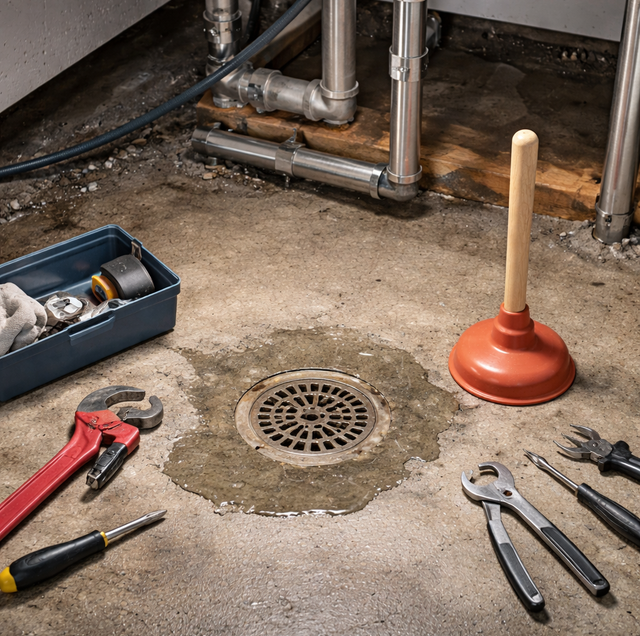
Quick Answer: A floor drain that backs up or gurgles when other fixtures run (the washer draining, a toilet flushing, the tub emptying) is usually signaling a restriction in the main sewer line, not a clog in the floor drain itself. A floor drain that is slow only when you pour water directly into it, with no reaction to other fixtures, points to a local problem like a plugged trap or debris in that one drain.
The floor drain in a basement, garage, or utility room is easy to forget until water pools around it. When it drains slowly, most people assume the drain itself is plugged and reach for a plunger or a bottle of cleaner. Sometimes that is the whole problem. Other times the floor drain is the only honest witness to a much bigger issue further down the system, and treating it as a local clog wastes time while the real restriction gets worse.
The distinction matters because the fix is different, the risk is different, and the cost of guessing wrong is a floor covered in wastewater. Understanding why the floor drain behaves the way it does lets you read the symptom correctly before anyone touches a tool.
Why The Lowest Drain Backs Up First
Every drain in a house feeds into progressively larger pipes that combine into one main line running out to the sewer or septic tank. That main line is the single road every gallon of wastewater has to travel. When something restricts it, water from upstairs and from the kitchen still leaves those fixtures normally at first, because gravity pushes it down into the main. The trouble shows up at the lowest opening.
Water finds its own level. When the main line cannot carry away everything being sent into it, the backed-up water rises inside the pipe and looks for the nearest low escape point. In most homes, that point is the floor drain, sitting at or below slab level in the basement or garage. It has the lowest rim of any drain in the building, so it overflows before a sink or a shower two floors up ever shows a symptom. The floor drain is essentially the relief valve for a system under stress, which is exactly why it is the first place a main-line problem announces itself.
Think of the main line as a funnel with a partial blockage at the narrow end. Pour slowly, and everything passes. Pour from several spouts at once, and the funnel fills from the bottom up, spilling over the lowest edge long before it reaches the top. The floor drain is that lowest edge.
The Tell-Tale Pattern To Watch For
A local clog and a main-line restriction feel different once you know what to listen for. The single most reliable clue is how the floor drain reacts to water used elsewhere in the house.
The main-line signature: Run the washing machine through its drain cycle, or flush a toilet, or empty a full bathtub, then go look at the floor drain. If it gurgles, bubbles up, or pushes water and debris out onto the floor while another fixture is discharging, the main line is restricted downstream of both. The washer is a strong test because it dumps a large volume of water fast, more than a sink ever does, so it stresses a marginal main line that lighter use would not expose. Gurgling is the sound of air being forced back up through the water in the floor drain trap as the pipe below struggles to breathe.
The local-clog signature: A floor drain with only a local problem stays quiet when other fixtures run. Water in the kitchen sink, the shower, and the toilets all disappears normally. The floor drain is slow or standing only when you pour water directly into it, and nothing else in the house reacts. That isolation is the signal that the issue lives in the floor drain or its own short branch, not in the shared main.
Timing helps too. A main-line restriction tends to get steadily worse and affects more fixtures over days or weeks. A local clog often appears suddenly and stays confined to the one drain.
When The Smell Is A Dried Trap, Not A Clog
Not every floor-drain complaint is about drainage speed. A common one is odor, and it is frequently mistaken for a clog when it is the opposite problem.
Every floor drain has a trap, a curved section of pipe that holds a small pool of water. That water seal blocks sewer gas from rising into the room. Floor drains rarely get used, so in a rarely run drain or a seldom-visited garage, the water in the trap slowly evaporates. Once it is gone, nothing stops sewer gas from drifting up, and you get a rotten-egg or musty smell around a drain that is otherwise draining fine.
The fix for a dried trap is simply pouring a quart or two of water down the drain to refill the seal, sometimes with a spoonful of mineral oil on top to slow future evaporation. If the smell clears and the drain was never slow to begin with, there was no clog at all. A persistent smell that returns despite a refilled trap, or a smell paired with slow drainage, is a different matter and points back toward a restriction or a cracked line.
If a rarely-used floor drain smells but drains fine, the trap has likely dried out. Pour a quart or two of water down the drain to refill the seal, and add a spoonful of mineral oil on top to slow future evaporation.
What Actually Restricts A Main Line
When the pattern points to the main, the underlying cause is usually one of a handful of things, and none of them respond to a plunger at the floor drain.
Grease and scale buildup: Cooking fats poured down the kitchen sink cool and congeal on pipe walls, layer after layer, narrowing the passage like plaque in an artery. In areas with hard water, mineral scale adds to the buildup. Over years, the effective diameter of the pipe shrinks until it can no longer carry a full load.
Root intrusion: Tree and shrub roots seek moisture and work their way into pipe joints and hairline cracks, then fan out into a mesh inside the line that snags paper and solids. Older clay or cast-iron sewer laterals are especially prone to this. Roots are the classic cause of a main line that clogs, gets cleared, and clogs again on a schedule.
A belly in the line: If a section of pipe has sagged, often because the soil beneath it settled or shifted, it forms a low spot that holds water and collects sediment. A belly cannot be snaked away because the pipe itself is misshapen, and it will keep catching debris until the section is corrected.
Flushed items that do not break down: So-called flushable wipes, paper towels, feminine products, and thick toilet paper hang up on any existing rough spot and build a dam. This is one of the most common sudden-onset main-line blockages.
How A Plumber Confirms The Real Problem
Guessing is risky, so a plumber confirms the location and cause rather than assuming. Two things make that possible.
The first is a cleanout, a capped access fitting that opens directly into the main line. Opening the correct cleanout tells a plumber a great deal on its own. If wastewater is standing in the cleanout, the blockage is downstream of it, out toward the street. If the cleanout is dry while the floor drain backs up, the blockage sits between the two. A word of caution here: a cleanout on a backed-up main can be under pressure from standing water, and removing the cap can release a sudden gush of contaminated water.
A cleanout on a backed-up main can be under pressure from standing water, and removing the cap can release a sudden gush of contaminated water. That is a job for a plumber wearing protection, not a homeowner leaning over the cap.
The second is a drain camera. A plumber feeds a waterproof camera on a flexible cable down the line and watches a live feed, which shows exactly what is there: a root mass, a grease ring, a collapsed section, or a belly holding water. The camera turns a guess into a diagnosis and often locates the trouble spot to within a foot, so any digging or repair is targeted rather than exploratory.
Why Chemical Cleaners Make A Main Blockage Worse
Reaching for a bottle of chemical drain cleaner is understandable and, on a main-line blockage, close to useless and sometimes dangerous.
Chemical cleaners are formulated for small, local clogs of hair or grease in a fixture trap a few feet from the opening. A main line holds far more water, and the blockage sits far past where the chemical can reach in any useful concentration. The product settles into the standing water, dilutes, and sits against a root mass or a solid dam without clearing it.
The danger comes next. That caustic liquid is now pooled in your pipes and, when the line finally has to be opened or augered, anyone working on it faces a splash-back of chemical mixed with sewage. The heat some of these products generate can also damage older pipe and the rubber seals at joints. Roots and bellies do not respond to chemistry at all, so the effort is spent while the real problem stands still. Mechanical clearing (an auger or high-pressure water jetting) and, when needed, a repair to the pipe itself are the tools that actually address a main-line restriction, and jetting in particular is pro work because of the pressure involved.
If your floor drain is actively backing up, the safe response is to stop running water in the house, keep people and pets away from the standing wastewater, ventilate the area, and call a plumber. Contaminated water carries bacteria, and the more water you send down while the main is blocked, the more comes back up onto the floor.
Frequently Asked Questions
Yes, and it usually means the blockage is complete rather than partial, or that the problem is outside your home entirely. A full backup with no water use often traces to a municipal sewer surge or a saturated line during heavy rain, when the public main pushes water back toward the lowest opening in connected homes. A backwater valve, a one-way flap installed on the building's main, is designed to stop that reverse flow and is worth asking about if your floor drain has flooded from outside pressure before.
It does, and a venting fault can mimic a clog. Floor drains connect to the same vent system that lets air into the pipes so water can flow smoothly. If the trap arm is too long or the vent is blocked by a bird nest or debris up on the roof, the drain can gurgle and drain slowly even with a clear main, because the water is fighting a vacuum. A plumber checking a stubborn slow floor drain will confirm the vent is open before assuming the line itself is restricted.
Not reliably, and it can backfire. Hot water may soften grease briefly, but as it cools further down the cooler pipe, the grease re-hardens past the reach of the flush, sometimes consolidating into a firmer plug downstream. Grease in a main line is cleared mechanically, and high-pressure jetting is the method that scours the pipe wall clean rather than just poking a hole through the blockage the way a cable can.
They present differently. A main-line restriction shows up as slow drainage, gurgling, and backups at the floor drain when fixtures run, all on the wastewater side. A slab leak is on the pressurized supply side and shows up as a warm or damp spot on the floor, a running-water sound with everything shut off, or an unexplained jump in the water bill. If the floor is wet but the drains are draining fine, suspect the supply line under the slab rather than the sewer.
No. A floor drain that is merely sluggish when you pour water into it, with no backups and no reaction to other fixtures, is often a minor local issue like sediment in the trap or a partially plugged branch, and it can wait for a scheduled visit. It becomes urgent the moment wastewater comes up onto the floor while other fixtures are in use, because that pattern means the shared main is failing and every flush adds to the mess.
Avoid it. The washing machine discharges the largest single slug of water of any household appliance, dozens of gallons in a short burst, which is exactly the load a compromised main line cannot handle. Running it is the surest way to push a backup out of the floor drain and across the floor. Hold off on the washer, the dishwasher, and long showers until the line is cleared, since each of those sends a heavy volume into the same restricted pipe.
Catch a main-line problem before it floods the floor — a camera inspection shows exactly what is going on. MNS Plumbing & Drain Cleaning serves Anthem and the Valley. ROC 262137. Call (602) 362-4524.
