
Cartridge or Ceramic Disc: Which Faucet Drips First?
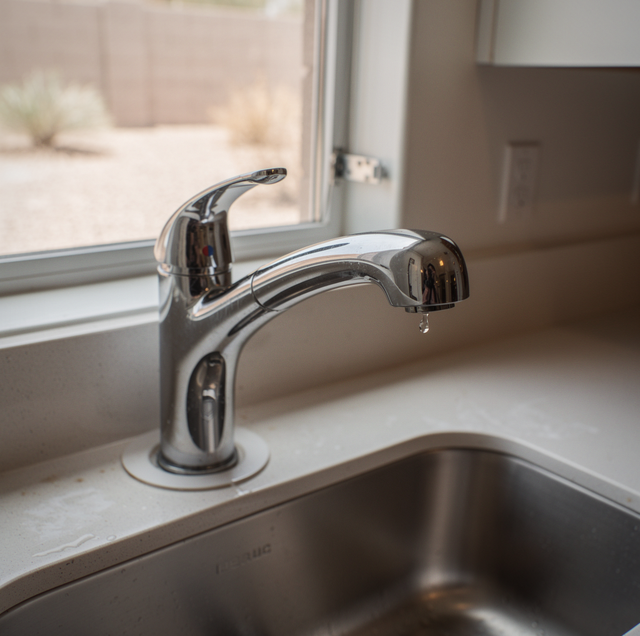
You turn the lever, and you can feel it through your hand. The travel has a fine grinding in it, as though something small is riding between two surfaces. And under the spout, the drip is back. You had this faucet apart once already: you matched the replacement part, set it in, the drip stopped for a season, and now it keeps the same slow rhythm.
Between the two, a ceramic disc pair has nothing at its sealing interface that wears the way rubber wears, so the failure that ends a cartridge never reaches it. What stops a disc pair in hard water is not wear at all. It is what the water leaves on the faces, so the hardness of your supply belongs in the choice between them.
How a Cartridge Holds the Water Back
A cartridge is a sleeve you can pull out of the faucet body in one piece. Inside it, a stem moves against ports cut through the shell, and what covers those ports at the closed position is rubber: a seat washer, or a set of O-rings. The brass around it stops a few thousandths of an inch short. The elastomer deforms into that gap and fills it. That deformation is the seal.
Rubber held compressed takes a compression set, the permanent loss of thickness after the load comes off, and because heat and time drive it, a standard test fixes a temperature and a holding period before it measures anything.
Your hot handle lives at the higher temperature, and its seal reaches the end of its rebound first. Once the rubber stops springing back to its original thickness, it reaches the closed position, short of the gap it used to fill. Water finds that shortfall. What you get at the spout is a drip that does not respond to turning the handle harder, because the handle is already at the end of its travel. That drip maintains a steady rate, and on a two-handle faucet, closing the cold handle alone leaves it running.
How Two Ceramic Discs Seal Against Each Other
A ceramic disc cartridge shuts off water with two flat alumina discs, an aluminum oxide ceramic. One disc is fixed in the base of the cartridge and carries the ports: hot in, cold in, mixed out. The other rides on top, keyed to the stem, and moves when you move the lever. Where the openings in the two discs overlap, water passes. Where the solid part of the upper disc covers the ports, it stops.
The seal happens without anything compressing. The two faces are finished flat and smooth enough to seal on contact, and line pressure presses the upper disc down onto the fixed one. The harder your supply pushes, the harder the pair is held together.
Alumina sits near 9 on the Mohs scale. Quartz, the sand that gets into a supply line, sits at 7, and calcium carbonate sits at 3. A mineral cannot scratch a face harder than itself, so the discs do not wear the way a rubber seal wears.
There is still rubber in a disc cartridge, at the base, as inlet seals holding it against the ports in the faucet body. Those can fail. When they do, water turns up under the handle or inside the body, which is a different fault from a drip at the spout.
What Does Hard Water Do to Each One?
Hardness is dissolved calcium and magnesium, reported in milligrams per liter as calcium carbonate, or in grains per gallon; one grain per gallon is 17.1 mg/L. A standard hardness classification puts anything above 180 mg/L, about 10.5 grains, in the very hard band. Your utility's annual water quality report carries the figure for your supply.
Calcium carbonate gets less soluble as water warms. A standard water-chemistry index takes water temperature as an input for that reason: a supply that stays in solution in your cold line can be depositing in your hot one. Both valve types scale on the hot side first.
On a cartridge, that deposit grows on the seat and on the face of the seal itself. The rubber has already lost rebound. Now it is also closing against a hard, uneven rim where it once met machined brass.
On a disc pair, nothing softens and nothing wears, but the deposit still lands. The grit arrives first, in your handle, because the discs are riding across deposit that has grown on the exposed ring of face. The drip comes later, when a flake of that deposit breaks loose and lands between the two faces. A disc that cannot come flat against its partner passes water, with no wear anywhere in the valve.
What Runs Out First in Each Valve
The two run on different clocks.
In a cartridge, the clock runs on the elastomer, whether or not anyone uses the faucet. A seal sits compressed for every hour the faucet is not running, at whatever temperature that line holds, the two conditions a standard test fixes before it measures anything. Working the handle adds abrasion, but the set accumulates without your help.
In a disc pair, there is no clock on the sealing faces at all. What runs there is a deposition rate that follows your hardness figure and your hot-water setting. Soft water and a disc pair is a combination with no consumable in the seal. Hard water and a disc pair still reaches a drip, but it arrives differently, and you feel it in the handle before you see it at the spout.
On a disc pair, shut the faucet, work the handle through its full travel three times, then shut it. A drip that changes or stops points to a particle between the faces; one that returns unchanged points to the faces themselves.
A drip and a weak stream are separate faults. Weak flow at a single fixture runs through the aerator screen and through the cartridge as a restriction rather than a failed seal, and that diagnosis is not this one.
There is also the case where a new part starts dripping inside a year. A replacement cartridge goes back into the same brass body it came out of, and that body has been in the same water the whole time.
Reading the Part Before You Order a Replacement
Whichever valve you have, ordering the right replacement comes down to what you can read off the old one. Close both supply valves under the sink, then open the faucet to release the line pressure. Then take out the handle, the retaining nut or clip, and the cartridge, in that order.
The brand name is cast or molded into the cartridge body. Look along the flat of the shell and around the base, and for any number molded beside it.
For a single-lever mixer, measure the diameter across the base in millimeters. Mixer cartridges are cataloged by that dimension: a 35 mm and a 40 mm are different parts, and neither sits in the other's body. Note which way the tab on the shell points, because a cartridge that goes back, rotated, puts the hot side on the cold side.
For a two-handle faucet, the part is a stem, and the detail that gets skipped is the splined end that drives your handle. That pattern is called the broach, and stems are indexed by the number of points on it: a 16-point and a 20-point stem of the same length are different parts. Photograph the splined end square-on, with a rule beside it, because the point count is the one thing a caliper will not give you.
Frequently Asked Questions
Turn the handle and watch the travel. A ceramic disc stem in a two-handle faucet reaches full flow in about ninety degrees and stops hard at both ends; the trade name for it is a quarter-turn cartridge. A handle needing two or three full turns to shut means you are turning a threaded stem instead. On a single-lever mixer, one smooth sweep of the lever means a disc pair is under it.
It changes one of the two problems. A softener exchanges the calcium and magnesium in your water for sodium, so it acts on what deposits on the sealing surfaces. It does nothing for an elastomer that has taken a set, and it does not take suspended particles out of your water; that is a sediment filter's job, and the particle size it catches is the micron rating printed on the filter cartridge.
Look at how the O-rings went in. The instruction sheet that comes with a replacement cartridge calls for silicone plumber's grease rated for potable water and warns you off petroleum-based lubricants because petroleum swells and softens the elastomers these seals are made from. A ring that went in dry can also roll or nick on its way into the bore, and a nicked ring leaks from the first day.
You can rinse the deposit off the faces if you get the cartridge open, and it can buy you time. What you cannot do is replace one disc. The pair is matched and set together when the cartridge is assembled, so single discs are not sold or cataloged. The serviceable rubber in that cartridge is the inlet seal set at its base, and that is what comes as a kit.
They do, and it is worth checking before you order. In a two-handle faucet, the hot and cold sides open in opposite directions, so the stem cartridges are handed. Put a cold-side stem on the hot side, and your handle runs backward and will not sit square at the closed position. The hand is marked on the part or on its packaging.
Lapping brings the two faces into flat contact with an abrasive slurry until they mate. Flatness is quoted in light bands: one band is about 0.0000116 inch, roughly three tenths of a micron, and disc faces are held to a fraction of one band. That flatness is the entire seal. Nothing elastic sits between them, so your disc pair has no rubber part to compress.
A drip that came back after a new cartridge is worth opening the valve for — disassembly puts the brass seat and the inside of the body under a light, where pitting and scoring are visible, and any new cartridge has to seal against that surface. MNS Plumbing & Drain Cleaning serves Anthem and the Valley. ROC 262137. Call (602) 362-4524.
