
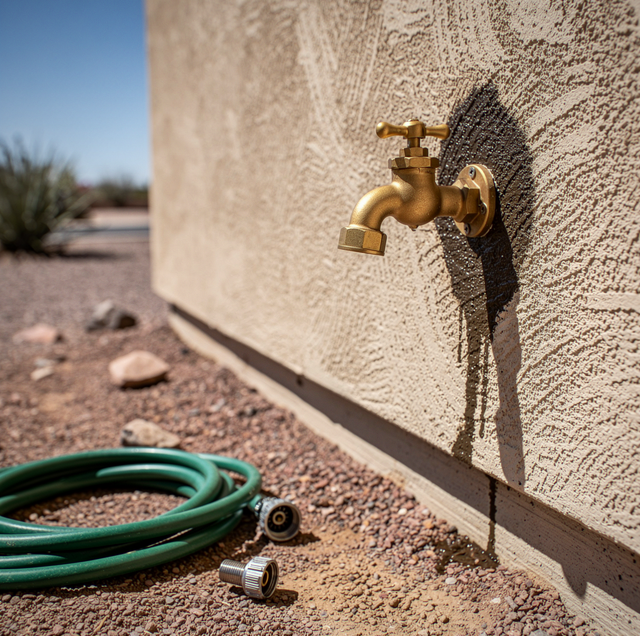
The hose comes off the reel and runs a sprinkler for an hour. Afterward, there is a dark patch under the spigot that was not there before, and it stays dark long after the sun should have dried it. The handle is shut all the way. It is still wet.
Quick Answer: Water at the spout with the handle shut is the seat washer. Water around the handle when the valve is open is the packing. Water behind the wall or at the pipe connection is neither, and it is the serious one.
Where the Water Shows Up Names the Fault
Take a plain compression hose bib apart, and there is not much to it. Water sits in the body under pressure the whole time the house has water. A threaded stem extends to the handle, and at its inner end, a rubber washer, held by a small brass screw, presses onto a machined brass ring called the seat. Turning the handle backs the stem out and lifts the washer clear. Where the stem leaves the body, a packing washer or a wrap of packing material is squeezed by the packing nut to seal around it.
Water at the spout with the handle fully closed means the washer is no longer sealing on the seat, or the seat is no longer a surface a washer can seal on. Water around the handle while the valve is open means the packing has given up and water is climbing the stem. Water on the inside face of the wall, on the foundation below the bib, or nowhere visible at all is the third case, and it is not a valve fault. It is the joint where the bib ties into the supply pipe, or the pipe behind it.
That third one runs a long time before anything shows, and sometimes the first sign is a water bill nobody can account for, which is a symptom with a list of causes of its own.
A Seat Washer Takes a Set and Stops Filling the Gap
The washer seals because the rubber deforms into every scratch and machining mark on the brass seat face, filling a gap that is never perfectly flat. That works only while the rubber can still spring back.
Elastomers, when held squashed, do not spring back forever, and heat takes the spring out the fastest. A washer clamped against a seat and cycled through hot season after hot season keeps a share of that deformation permanently. Rubber engineers call it compression set: the percentage of the original squeeze that never returns once the load comes off. Nitrile and EPDM, the two materials most bib washers are made from, both set faster as working temperature climbs.
So the washer holds a permanent impression of the seat instead of conforming to it fresh each time the handle closes. In April it still fills the gap. After the first stretch of real heat it does not, and the drip starts at the spout with the handle shut tight. Cranking the handle harder crushes what is left of the rubber and scores the seat underneath.
Years of flow carry grit across that brass ring, leaving it pitted, and a new washer on a scored seat seals for a few weeks, then weeps again. The same arrangement sits inside older interior faucets and fails the same way; outdoors it is the heat, the pressure swing and the hose that get there first. A washer holding a permanent impression of the seat is sealing on a margin, and margins are pressure-dependent, so the same washer that held all spring can pass a thread of water on a day the street pressure runs at the top of its range.
The Packing Loses Its Preload Through the Season
The packing nut seals by preload, squeezing the packing sideways against the stem, and preload is what a temperature cycle takes away. Surface temperature on a sun-facing bib can swing fifty degrees Fahrenheit or more between a hot afternoon and four in the morning, and the packing material creeps a fraction under load with every cycle, so the nut that was snug in April is a quarter turn short by July.
The body is under supply pressure whether the handle is open or closed, so the packing holds back the pressure all day. What changes on opening is which part of the stem it has to seal against. The stem rises as it turns, and the length of brass that sits inside the wet body when the valve is closed gets drawn up into the packing when it opens. That section carries mineral film and light corrosion. Packing that seals against the polished upper stem cannot seal against a rough one, so water tracks out under the handle and stops the moment the valve closes.
A Hose Left Connected Keeps the Valve Loaded All Season
A hose is rarely left attached with the bib shut. It is left attached with the bib open and a shut-off nozzle holding the water back at the far end, which changes what the bib carries from a few hours a week to around the clock.
With the valve held open all season, the stem remains at the top of its travel, so the packing is continuously squeezed against that rough, wetted brass without a break, and the anti-siphon device on the outlet maintains pressure constantly rather than only during use. The hose becomes a pressurized vessel lying in direct sun. Water trapped between a closed nozzle and an open bib heats well past a hundred degrees on a hot afternoon and has nowhere to expand, so pressure inside it climbs above what the supply delivers.
Disconnect the hose before judging a drip. A hose charged all afternoon drains through the spout and the vent when it comes off, and a fixture wet from that reads as a failed seat washer. Dry the bib and wait ten minutes.
The Vacuum Breaker Has Its Own Seal and Its Own Repair
The small cap threaded onto the outlet of most outdoor faucets is an anti-siphon vacuum breaker, a separate device with its own failure mode. It prevents water in a hose from being drawn backward into the house supply if upstream pressure drops.
Inside sits a poppet with a rubber seal and a vent to outside air. When water flows, the poppet lifts and closes the vent. When flow stops, the vent opens, and the column of water in the hose cannot siphon back because air gets in behind it.
A short spray from that cap the instant you close the handle is not a fault. The vent is opening to break the column so the hose can drain. What signals a bad seal is water that keeps coming from the vent while the valve is running, and it appears from around the cap at the top of the spout, above the hose threads rather than at the outlet. Replacing the seat washer does nothing for it, which is why this one gets rebuilt twice.
This is the simplest repair on the fixture. Add-on breakers come with a replacement seal kit, or as a new unit that threads onto the spout in minutes. Many carry a set screw whose head snaps off during installation so the device cannot be casually removed, which is a design choice rather than a fault.
A Frost-Free Sillcock Fails Inside the Wall, Not at the Handle
A frost-free bib, or sillcock, is not a short valve with a long handle. It is a tube, commonly six to twelve inches or more, running from the outside wall through to the heated side, with the valve seat at the far inner end.
The seat and the connection to the supply pipe are inside the building envelope, so a frost-free connection that leaks at its body or its joint leaks into insulation, framing, and drywall with the outside of the wall bone dry. Nothing about the spigot looks wrong.
And it leaks only when the valve is open. With the handle shut, the seat holds water at the inner end, and the tube outside it drains empty, which is the whole point of the design. A split anywhere along that tube stays silent until someone opens the handle and pressurizes it.
A hose left connected over winter is the classic cause. The tube cannot drain; water sits in the cold section, freezes, expands, and splits the copper. The seat still seals, so the winter passes with no sign, and the failure surfaces on the first use of the year, whenever that comes. A frost-free also drains only if it was installed pitched slightly downward toward the outside.
None of this is a washer job. A split tube, or a failed soldered or press connection where the sillcock ties into the supply, is a replacement, and the work happens on the inside of that wall.
What You Can Confirm, and What You Cannot
The diagnosis costs a rag and five minutes.
Dry the whole fixture and watch it with the handle fully closed: water returning at the spout is the seat side. Open the valve and watch the handle, because water rising around the stem is the packing. Take the hose off and repeat both. Then look at where the water actually starts, above the hose threads at the vent cap or below them at the outlet.
On a plain compression bib, acting on that answer is fair homeowner work. Replacing a seat washer and its brass screw, or renewing the packing and setting the nut back to a proper preload, are ordinary repairs with ordinary tools.
Shut the supply and open the bib to relieve pressure before loosening a packing nut or bonnet. A stem under line pressure can drive out when the nut clears its threads, and the water behind it does not stop.
The third location cannot be confirmed from outside at all. Nothing at the spigot tells you whether the connection behind it is sound, whether a frost-free tube is split, or whether the wall cavity is wet. Anything behind the wall, anything on a frost-free, and any soldered or press connection is a plumber's call.
Treat that case as a damage question as much as a plumbing one. Wet framing and saturated insulation in a closed cavity have no airflow to dry them, and mold follows sustained moisture. Delay is the expensive part, not the repair.
Frequently Asked Questions
Turn the water on, then shut the handle and listen. A frost-free sillcock keeps running out of the spout for a second or two after the handle stops, because the length of tube outside the seat is draining itself. A standard bib stops the instant the washer meets the seat. The handle on a frost-free is also usually set at a downward angle rather than square to the wall.
It works on both sealing surfaces. Mineral scale plates onto the brass seat and leaves an uneven face a flat washer cannot conform to, and loose grit carried in the flow can lodge under the washer as it closes and cut a channel across it. A bib on hard water often needs the seat dressed or replaced along with the washer.
Often, yes, and it is worth trying first. Snug it an eighth to a quarter turn at a time with the valve open, and stop as soon as the weeping stops. Going further binds the stem, stiffens the handle, and scores the brass the packing is meant to seal against. If several small turns do not stop it, older bibs take graphite-impregnated packing string wound around the stem in place of a formed washer.
Usually not. The seal at that joint is a flat rubber hose washer sitting inside the female coupling on the hose, not in the faucet, and it flattens and cracks with age and heat. Replace it before touching the valve. If the coupling is out of round from being driven over or dropped, no washer will seal it, and the hose end has to be cut off and a new coupling fitted.
It depends on the seat. Some bibs have a replaceable seat that unscrews with a square seat wrench, and those rebuild cleanly for years. Others have the seat machined into the body, and once it is pitted, it can be dressed flat with a seat-grinding tool only so many times before there is too little metal left. A body that has been dressed once already is a replacement.
It usually is, one step earlier. The noise is the washer fluttering in the flow because the brass screw holding it has worked loose or the rubber has hardened and no longer sits flat against the stem. It shows up at partial openings, where flow velocity across the washer is highest, and disappears wide open. Treat it as notice that the washer is on its way out.
Find out which of the three leaks you have — a bib that drips at the spout, weeps at the handle, or wets the wall behind it needs three different repairs, and only one of them is a washer. MNS Plumbing & Drain Cleaning serves Anthem and the Valley. ROC 262137. Call (602) 362-4524.
