
New Softener, Still White Spots? Five Things to Check
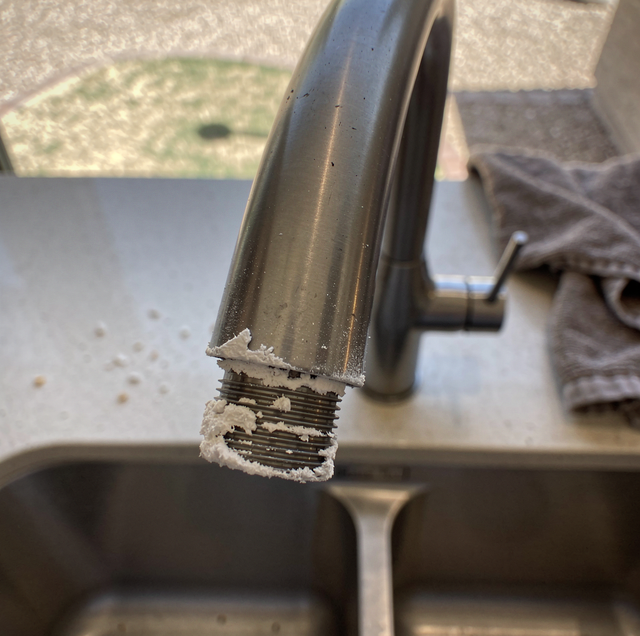
The softener went in six weeks ago. The brine tank has salt in it; the shampoo lathers with about half as much as you used to squeeze out; and the shower door feels different under your hand when you wipe it. The glass still dries with the same chalky white film. So do the faucet spouts, the sink rims, and the underside of the kettle lid.
Soft water at the tap and white deposits on the surface can coexist for five distinct reasons. A plumber works through them in a fixed order because the common, cheap causes sit at the front of the list and the expensive ones sit at the back. Running the list backward is how a perfectly good unit gets condemned.
Quick Answer: A new softener can still leave white deposits for five reasons: the unit sits in bypass, the fixture is plumbed around the loop, the head never regenerates, the deposit was never hardness, or old scale is still shedding downstream.
Whether the Softener Is Treating That Fixture at All
Every softener has a bypass, a valve arrangement that routes house water around the tank so the unit can be serviced without shutting off the home. It is used during installation to flush debris from the lines before water is sent through the fresh resin. Turning it back is the last step, and it is the step that gets skipped when an installer is interrupted or finishes late.
A unit left in bypass gives away almost nothing. The display lights up. The tank is full of salt. Nothing leaks. The one tell is that a metered head sees no flow, so it never counts down or regenerates, and the salt level in the brine tank remains at exactly the height it was on day one. Salt that has not moved in a month is worth mentioning to whoever installed the unit.
The loop matters as much as the valve: Most homes feed a softener through a dedicated loop, and the plumbing around that loop is deliberate. Outside hose bibs are almost always teed off ahead of the loop, so irrigation and hose water stay untreated, and salt is not applied to the yard. In some homes the kitchen cold is left off the loop too, because a separate drinking-water tap serves that sink. If the fixture that keeps spotting is on one of those untreated branches, the unit can be running exactly as designed while the deposit continues.
A plumber settles this by testing water at the fixture in question and at an untreated point, then tracing where the loop picks up and drops off.
Whether the Unit Is Regenerating on Schedule
Resin only exchanges hardness ions as long as it is recharged with brine. Three things break that cycle.
Salt bridging: Regeneration needs saturated brine, and brine only forms where water and salt are actually touching. In a hot, humid garage, the pellets can cement themselves into a rigid shelf partway up the tank, wedged firmly enough against the sidewall to carry its own weight, with the water sitting in a void beneath it. Nothing dissolves, the cycle draws something close to plain water, and the resin finishes the cycle still holding the calcium it started with. Looking down into the tank shows a full load of salt, because the shelf is what you are looking at. The giveaway is a salt level that holds the same height month after month while hard water keeps arriving.
Do not drive a broom handle or any tool into the brine tank to break up hardened salt. The brine well and the draw components inside are easy to crack, and a damaged line turns a service call into a replacement.
The head programmed wrong: A metered head regenerates based on gallons used; a timer head regenerates on a clock regardless of use. A metered head has to be told the incoming hardness so it can calculate how many gallons the resin will handle. Give it a number lower than the real one, and it schedules regeneration too late, so the resin runs out of capacity near the end of each cycle. That produces spotting that comes and goes: clean glass for several days, then a stretch of film, then clean again after the unit cycles. A metered head set to run as a timer does the same whenever use climbs.
A failed brine draw: The injector that pulls brine out of the tank runs on a narrow passage and clogs with sediment or salt fines. When it does, the cycle advances on the display, water goes to the drain, and no brine reaches the resin. The tell is the opposite of salt bridging: the water level in the brine tank creeps up over weeks and never drops.
Deposits a Softener Was Never Able to Stop
Ion exchange is a trade. The resin holds sodium ions and swaps them for the calcium and magnesium that make water hard. That is the whole mechanism. Anything dissolved in the water that is not a hardness ion goes through the tank unchanged and lands on the fixture when the water dries.
Two things ride through routinely. Dissolved silica travels as an uncharged molecule at ordinary household pH, so the resin has nothing to trade for it, and it dries into a stubborn film that ordinary cleaners barely touch. Total dissolved solids, the running total of everything in solution, includes the calcium and magnesium a softener exchanges alongside the sodium, chloride, sulfate, and bicarbonate it does not, and because exchange swaps one ion for another rather than removing mass, the total survives softening and, in fact, nudges slightly upward.
Then there is the film softening creates. Softened water and soap rinse differently, and the slick gray-white smear people notice on shower walls after an install is soap residue rather than mineral. Press a finger to it: a deposit that smears and then rinses away under plain water came off the soap, and it dries without leaving a crust.
| What the deposit looks like | What it is | Does a softener touch it |
|---|---|---|
| Chalky white crust that flakes off, thickest at spouts, aerators, and heating surfaces | Calcium and magnesium carbonate scale | Yes. Removing the hardness ions stops new scale from forming |
| Glassy or cloudy film that will not scrape off cleanly and shrugs off normal cleaners | Silica | No. Silica passes through the resin untouched |
| Flat dull haze across the whole surface that returns every time water dries | Dissolved solids left behind as water evaporates | No. Those solids pass through the softener unchanged |
| Slick gray-white smear on shower walls and glass that wipes with a cloth | Soap that has not fully rinsed away | No. Softening reduces true soap scum, and this film rinses off with plain water |
Old Scale That Formed Before Installation
A softener changes what comes into the house. It does nothing about what is already sitting inside it.
A water heater that ran for years on untreated water carries a scale layer on the tank floor and along the dip tube, and holds a full tank of water in contact with all of it. Fixture internals hold their own share: aerator screens, shower cartridges, and the passages inside a tub and shower mixing valve all trap deposit in places water moves slowly. None of that leaves because a new tank went in upstream.
Softened water is mildly aggressive toward those old deposits, and lifts flakes off them. So for a stretch after installation, white grit shows up in aerator screens, and in the bottom of the tub, and hot-side fixtures keep spotting longer than cold ones because the heater holds the biggest reservoir of loaded water and loose material. That grit is an old deposit leaving the system, and it thins as its supply runs down.
How long that takes depends on how much deposit is in there, which is a judgment call a plumber makes from the heater's age and condition.
What a Water Test Distinguishes
A hardness test measures calcium and magnesium and reports in grains per gallon. It answers one question and only one: is the water leaving this tap softened? Run at an untreated point, it establishes what is coming into the house; run at the fixture that keeps spotting, it establishes whether the unit is doing its job at that fixture. A pair of readings that match each other points at the bypass or the loop. A treated reading that reads hard points at regeneration.
A total dissolved solids meter reports in parts per million and covers different ground. A softener will not pull that number down, and a small rise after installation is normal rather than a fault.
Silica shows on neither one. It takes a lab panel, which is also where iron, manganese, and pH come back, and it is the test a plumber orders once hardness has come back clean at the treated tap and the deposit is still there.
The hardness figure a plumber programs into the head should come from a test of your own water rather than a published area average. Ask what number yours was set to and what the test measured; the two should agree.
Sorting the Deposit From the Equipment
The bypass check, the loop trace, the salt level, and the head settings determine whether the equipment is doing what it was bought to do. The water panel settles a separate matter: whether the deposit was ever something ion exchange could address.
A unit that passes a hardness test at the treated tap has done its job, even while the glass keeps spotting. At that point the answer sits in a different stage of treatment, or in the old scale still working its way out of the heater, and replacing the softener changes nothing. A unit that fails it has a specific fault behind it, usually one of the three regeneration problems rather than the tank.
Start with the salt level and the valve, since they cost nothing to check. Move to the test, because the test tells you whether you are arguing with the equipment or with the water.
Frequently Asked Questions
No. Ion exchange resin trades cations, and chlorine, chloramine, and most taste and odor compounds move through the resin bed untouched. Those are handled by activated carbon, a separate media stage that sits either in its own tank ahead of the softener or in a combined cartridge. Dissolved iron past a low threshold also needs treatment of its own, because iron fouls softener resin rather than being cleanly removed by it.
It does. Evaporated salt pellets are close to pure sodium chloride. Solar crystals carry more mineral matter, and rock salt carries the most, including insolubles that settle out and pack into the bottom of the brine tank. That residue is why a tank fed cheap salt needs cleaning out far sooner than one fed pellets, and why the cheaper bag often costs more across the life of the unit.
Yes. Sizing matches the unit's grain capacity against household demand, which is people times daily water use times incoming hardness. An undersized unit regenerates far more often than it should, burns through salt, and can exhaust its capacity between cycles during heavy use, so water tests soft in the morning and hard in the evening. Sizing is fixed at purchase and does not adjust when a household grows.
Usually. Calcium carbonate has inverse solubility, meaning it comes out of solution as temperature rises rather than dissolving further. Most dissolved salts behave the opposite way and hold in solution better as water warms, which is what makes carbonate the odd one and makes heat the single variable working against you. The effect starts well below the boil, so lowering a heater's setpoint slows the deposit rather than stopping it.
It helps a great deal. A tankless unit heats water inside narrow heat exchanger passages, where even a thin scale layer restricts flow and forces the burner to work harder to hit its set point. Many tankless units require or strongly recommend treated water to keep the warranty in force, and units are normally installed with isolation valves so a plumber can circulate descaling solution through the exchanger during service.
Yes. A reverse osmosis system under a sink drives water against a semipermeable membrane on household line pressure alone, sends a share of the feed water to the drain as reject, and holds the small volume it produces in a storage tank until the faucet opens. Output is slow by design, which is why it feeds one tap and the appliance lines run from it rather than a shower.
Sort out whether it is the equipment or the water — a hardness reading at the treated tap, plus a check of the bypass, brine tank, and head settings, tells you which of the five causes is leaving deposits behind. MNS Plumbing & Drain Cleaning serves Anthem and the Valley. ROC 262137. Call (602) 362-4524.
