
Whole House Low Water Pressure? 8 Culprits to Check
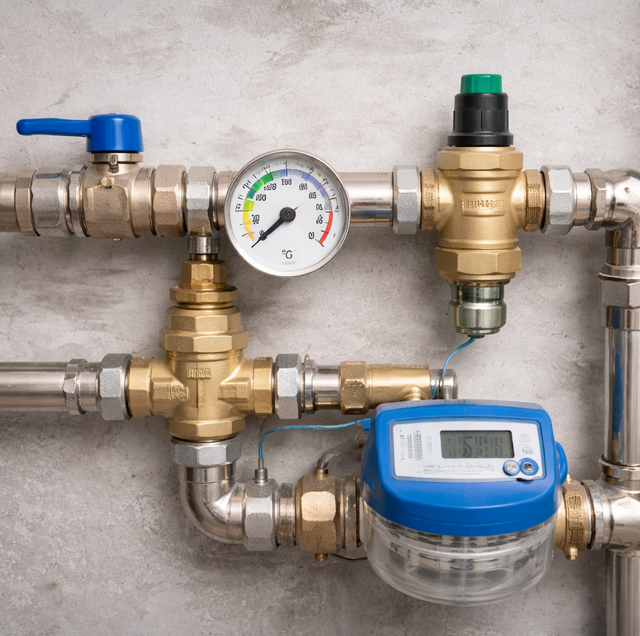
Quick Answer: If every fixture in the house runs weak at once, the cause is almost never the fixtures. It sits upstream of them, in the main supply line, the shutoff or meter valve, the pressure-reducing valve, or the pipes feeding the whole home. Start by confirming the main and meter valves are fully open, then measure pressure at an outside hose bib with a gauge. That single test tells you whether the shortage is coming from the street or starting inside your walls.
Weak water at one faucet is a local problem. Weak water at every faucet is a supply problem. That difference is the most useful thing you can know before you start troubleshooting, because it tells you where to look and, just as important, where not to waste your time.
Single Fixture Versus Whole House: Read the Pattern First
Water reaches your fixtures through a branching system. Municipal or well water enters through one main line, passes a meter and a main shutoff, often runs through a pressure-reducing valve, then splits into branch lines that feed each sink, shower, toilet, and hose bib. A problem at the far end of that tree affects only the fixture it feeds. A problem near the trunk affects everything downstream.
So when only the master bath faucet dribbles, the odds point to that faucet: a clogged aerator, a corroded supply stop, or a bad cartridge. Clean the aerator, and it usually returns. But when the kitchen, both bathrooms, the laundry, and the outside hose bib all run weak together, no single aerator can explain it. Something shared by all of them has narrowed, closed partway, or lost supply.
Run a quick census before anything else. Turn on the cold at three or four fixtures in different parts of the house. If they are all weak, and both hot and cold are affected, you have a whole-house issue and the causes below apply. If only the hot side is weak everywhere, look at the water heater and its shutoff instead, since that is a different branch of the tree.
The Common Whole-House Causes
A partially closed main shutoff or meter valve: This is the first thing to rule out because it is the easiest to fix and the most often overlooked. A main shutoff that was closed during a repair and never fully reopened will choke the entire house. Gate valves, the round-handle type, are the usual offender because they can seize partway. The meter valve on the street side does the same. Both should be fully open.
A pressure-reducing valve stuck low: Many homes on municipal water have a pressure-reducing valve, or PRV, a bell-shaped brass fitting usually mounted where the main line enters the house. It steps incoming street pressure down to a safe household range, commonly around 50 to 60 psi. PRVs wear out. When the internal diaphragm or spring fails, the valve can drift and clamp pressure far lower than it should, starving every fixture at once. A PRV problem often shows up as a house that was fine for years and then slowly, or suddenly, went flat everywhere.
Clogged or corroded galvanized supply pipes: Homes plumbed with galvanized steel decades ago face a slow narrowing from the inside out. The zinc coating breaks down, rust and mineral scale build up on the pipe walls, and the usable diameter shrinks year after year until flow drops noticeably. Because the whole system is affected, pressure falls house-wide. This is one of the few causes that gets worse gradually rather than appearing overnight, and it is the classic reason an older home needs repiping.
A hidden leak or slab leak: Water escaping before it reaches your fixtures is water that never builds pressure at the tap. A supply leak inside a wall, under the yard, or beneath a concrete slab bleeds off flow continuously. Watch for warning signs: a warm spot on the floor, the sound of running water when everything is off, unexplained damp patches, or a water bill that climbs with no change in habits. A hidden leak is not only a pressure problem. Trapped moisture feeds rot and mold, so finding it fast protects the structure, not just the flow.
Hard-water scale narrowing pipes and fixtures: Mineral-heavy water deposits calcium and magnesium scale over time, coating the inside of pipes, valves, and fixture passages the way limescale coats a kettle. In areas with very hard water, this buildup accumulates across the whole system and slowly restricts flow everywhere at once, not just at one tap.
A municipal supply issue or peak-demand drop: Sometimes the shortage is not yours at all. A water main break, hydrant flushing, utility work, or simple peak-hour demand on the street can drop pressure across a whole block. If your low pressure comes and goes on a schedule, worst in the early morning or evening when the neighborhood draws hardest, suspect the street.
A clogged whole-house filter or softener problem: A whole-house sediment filter that has not been changed acts like a slow drain on the entire system as it loads up with grit. A water softener with a stuck valve or a fouled resin bed does the same, since all the water passes through it. Both sit inline ahead of the branch lines, so a fault there pulls pressure down everywhere downstream.
On a well: a pressure tank, pump, or switch issue: Homes on a private well make their own pressure with a pump, a pressure tank, and a pressure switch that cycles the pump between a low cut-in and a high cut-out setting, often 40 and 60 psi. A waterlogged tank with a failed bladder, a switch set too low, or a tiring pump all show up as weak flow throughout the house. This branch of causes replaces the municipal ones entirely for well owners.
Narrowing It Down: The DIY Checks
You can localize most whole-house pressure problems yourself with a few careful steps, no special skill required.
Measure the pressure: Buy a simple water pressure gauge that threads onto a hose bib. Screw it onto an outside spigot, open the spigot fully, and read the number with no other water running. Normal residential pressure lands roughly between 40 and 80 psi. A reading well under 40 confirms the shortage is real and system-wide, and gives you a baseline to compare against later.
Confirm the valves are fully open: Trace your main line to the shutoff inside or just outside the house and make sure the valve is open all the way. If it is a round gate valve, turn it counterclockwise until it stops, then back off a quarter turn. Check the meter valve too, if you can safely reach it.
A stuck or corroded main valve should never be forced. If it will not move easily, stop, because a valve that snaps can flood the house before you can close it. Know where your meter and main are so you can shut water off in a hurry.
Check the PRV: If your home has a pressure-reducing valve and your gauge reads low, the PRV is a prime suspect. Some have an adjustment screw, but a PRV that has failed internally will not respond to adjustment and needs replacement, which is a plumber's job.
A thirty-second conversation with a neighbor can save an afternoon of troubleshooting. If the house next door is also running weak, the problem is on the street and belongs to the utility, not to you.
Bypass or replace a clogged filter: If your whole-house filter is overdue, swap the cartridge or, if the housing has a bypass, route around it temporarily. If pressure jumps back the moment the filter is bypassed, you found your answer.
Your plumbing behaves like a highway at rush hour. One stalled car in a driveway slows only that driveway, but a lane closure on the on-ramp backs up every car heading into the city. Whole-house pressure loss is an on-ramp problem, so look where all the water enters, not at the individual off-ramps.
When to Call a Plumber
Some of these causes are yours to solve. Others are firmly in professional territory, both for safety and because guessing wrong sends you down the wrong repair.
Call a plumber when the gauge reads low and the valves are confirmed open, since that points to a failed PRV or a system-wide restriction that needs diagnosis. Call when an older home shows the slow, creeping pressure loss that signals corroded galvanized pipe, because repiping is a planned job, not a patch. Call immediately if you see the signature of a hidden leak: a spiking water bill, the sound of water running with every fixture off, a warm or damp spot on a floor or wall. A sudden pressure drop paired with any wet spot is a leak until proven otherwise, and both the water loss and the mold risk climb the longer it waits.
Adjusting or swapping a PRV, opening a wall to chase a slab leak, and repiping a house are all work that calls for the right tools, a license, and the ability to shut down and restart the system safely. Getting a firm diagnosis first means you fix the actual cause once, instead of chasing the wrong repair twice.
Frequently Asked Questions
They feel identical at the tap, but they are not the same measurement. Pressure is the force pushing water, measured in psi on a static gauge. Flow rate is the volume delivered over time, measured in gallons per minute. You can have healthy static pressure that collapses the moment several fixtures open, which points to an undersized or scaled-up supply line rather than a pressure fault. A plumber sometimes runs a flow test alongside a pressure reading precisely to tell these two apart.
Yes, and it is a common trap. If cold pressure is normal everywhere but hot is weak everywhere, the water heater branch is the suspect, not the whole-house supply. Sediment buildup in the tank bottom, a partly closed shutoff on the heater's cold inlet, or scale in the heater's nipples can throttle hot flow throughout the house while cold stays fine. The cold-versus-hot census separates this from a true whole-house cause.
It can when it fails. An expansion tank is a small tank installed near the water heater on closed systems to absorb the pressure spike created when water heats and expands. A waterlogged expansion tank with a ruptured bladder will not lower baseline pressure the way a PRV does, but it lets pressure swing wildly, spiking high after the heater runs and sagging afterward. If your pressure reading changes minute to minute rather than staying steady, have the expansion tank checked.
No, and this is a frequent misdiagnosis. Low-flow fixtures are designed for a given supply pressure; they cannot create pressure the system does not deliver. If the whole house is starved, a new faucet or toilet will run just as weak. Fixture upgrades solve clogged aerators and worn cartridges at a single fixture, not a system-wide shortage upstream.
It varies with water chemistry, but galvanized supply lines typically deliver acceptable flow for several decades before internal corrosion and scale close them enough to notice. The tell is that pressure was fine for years and declined gradually, never suddenly. Cutting a short section of suspect pipe and looking at the bore is the definitive check; a pipe that started at three-quarter-inch inside diameter can shrink to the width of a pencil.
Only within limits, and only if the PRV is actually healthy. Household pressure above roughly 80 psi stresses supply lines, appliance valves, and connections, and it can void appliance warranties and trigger leaks or burst hoses. Turning up a failing PRV does not fix a failing PRV; it masks the symptom until the valve gives out entirely. If a modest, correct setting still leaves the house weak, the restriction is elsewhere, and the PRV is not the lever to pull.
Book a whole-house pressure diagnosis — pinpoint the real cause before you pay for the wrong repair. MNS Plumbing serves Anthem, Phoenix, and Scottsdale. ROC 262137. Call (602) 362-4524.
