
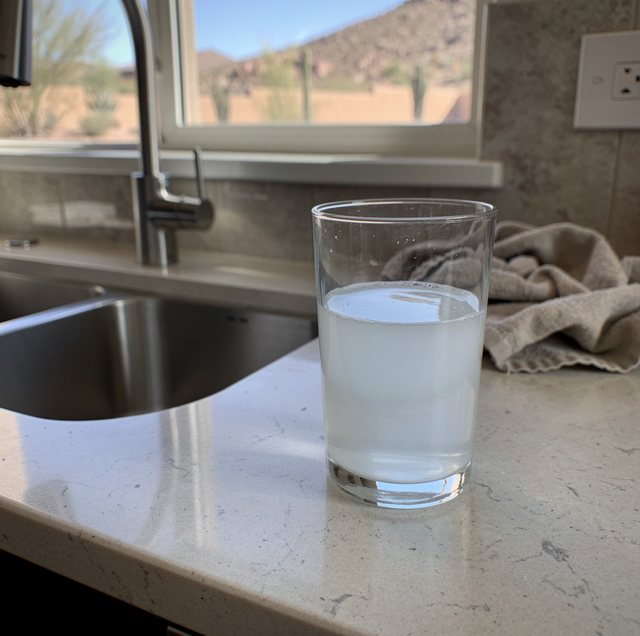
A glass filled straight from the tap can look off in two ways. Sometimes it's a milky haze that fades from the bottom of the glass upward, gone in a minute. Sometimes it's tinted brown or orange, or carries flecks visible when the glass is held to the light. Those two pictures point in different directions, and telling them apart determines whether the water needs attention or not.
The two patterns split the diagnosis in half. A haze that clears from the bottom up is trapped air escaping the water as pressure drops. Color or visible particles mean something in the water heater, the pipes, or the supply is contributing material the water picked up on its way to the tap. Each branch has its own set of causes, and each has one check you can run yourself before deciding what to do next.
Cloudy Water That Clears from the Bottom Up: Trapped Air
Water under pressure holds more dissolved air than water at rest. The moment it leaves a faucet and drops to normal pressure, the air comes out of solution as thousands of tiny bubbles, and the bubbles scatter light, giving the milky look. Because the bubbles rise and pop, the cloudiness disappears starting at the bottom of the glass and works upward until the water is clear again, within a minute or two.
Fill a clear glass and set it on the counter without touching it: If the haze clears from the bottom up within a couple of minutes and nothing settles at the bottom, that's air, and it isn't a water-quality issue at all. It shows up more after work on the plumbing system, after the water has been off and back on, or on very cold mornings when the water holds more dissolved gas. None of that calls for a fixture repair; it's a byproduct of how the system is behaving, not a defect in it.
If the water is tinted rather than merely cloudy, or if it carries visible flecks that don't disappear on their own, the water picked up material somewhere between the source and the faucet. That's a different question, and it has four places to look.
Hot Water Only: The Water Heater
Run the cold tap first, then the hot tap at the same fixture: If the cold runs clear and only the hot carries color or particles, the water heater, or galvanized pipe on the hot side, is the source; a plumber can confirm whether it is the tank itself by drawing from the heater's drain. Inside a tank-style heater, sediment settles on the bottom, and the anode rod sacrifices itself to protect the steel tank as it corrodes. Stir either one up, whether from a burst of high demand, a change in pressure, or the tank simply aging, and the loosened material rides out through the hot line the next time someone draws water. Rust-red or orange color on the hot side indicates the tank's interior lining is wearing through to bare steel; gray or black flecks indicate a disintegrating anode rod shedding material instead. A tankless unit can also shed mineral scale from its heat exchanger into the hot line, though it has no tank bottom to rust through.
Pale or white flecks need one more look. Extremely hard water can leave mineral scale behind, and scale flecks dropped in white vinegar will fizz and dissolve. Flecks that stay put in the vinegar and look like plastic point to a breaking-down dip tube instead. On soft water, scale is a minor factor, and pale flecks point to the dip tube.
Draw hot water into a white bowl and let it sit for a minute; what settles and its color (gray, white, red-brown, or black) are worth a photo for the plumber.
Whichever pattern shows up, the fix stays with a plumber rather than the tank's own access panel.
A tank shedding rust or anode debris can contain scalding water under pressure, and opening its drain, relief valve, or anode port can release it without warning. Leave draining, flushing and anode work to a plumber; your check stops at the taps.
One Fixture, Both Hot and Cold: The Fixture or Its Branch Line
If only one sink or tub shows color, and both its hot and cold run that way, the cause is local to that fixture's line, not the water heater or the main supply. A galvanized steel branch line corrodes from the inside over the decades, and rust flakes loose into the water passing through it. An old or corroded aerator screen or cartridge inside the faucet itself can shed the same kind of debris right at the point of use, which is why pulling the aerator and running the tap without it is worth trying before assuming the pipe itself is at fault. Because the branch line only affects the fixtures downstream of that section of pipe, the rest of the house running clear while one bathroom runs rusty is itself a diagnostic clue pointing at that specific run rather than anything upstream of it.
Whole House, Every Fixture: The Interior Plumbing
When color or sediment shows up at every fixture, hot and cold alike, the material is entering before the water splits off toward individual lines, which points to the main supply pipe into the house or a shared section of galvanized pipe feeding multiple branches. Older galvanized supply lines corrode along their whole length as the zinc coating wears through, and the corrosion narrows the pipe's interior while shedding rust into the flow. A repiped section that ties back into an aging galvanized main can still pull rust from the older segment upstream of the connection, so a partial repipe doesn't always eliminate this pattern if the older pipe still feeds it.
Discolored Right after the Meter or Only for a Few Minutes: The Supply Side
Sometimes the color shows up the moment you turn any tap in the house, clears within a few minutes of running, and comes back later that day or the next. That pattern points outside the house altogether, to work on the water main, a hydrant flush, or a break somewhere on the utility's side of the meter that stirred up sediment already sitting in the pipe. Running an outside hose bib on full for several minutes is the check here: water that clears and stays clear supports a supply-side disturbance rather than anything inside the home's own plumbing, since the interior pipes weren't the source and simply passed the disturbed water through. Discolored water that keeps returning at every fixture with no clear pattern, or that carries a foul odor, warrants a plumber's inspection of the supply and interior lines rather than repeated flushing.
What the Check Tells You to Do Next
Each of the four checks points to its own next step. A hot-only pattern traced to the water heater is work for a plumber who services or replaces tanks and anode rods; age and a corroding tank both weigh toward replacement. A single-fixture pattern points first to a cleaned or replaced aerator at that fixture, or to a branch line worth having inspected if the aerator isn't the source. A whole-house pattern with no supply-side disturbance to explain it points to the home's own supply piping and warrants a plumber's evaluation of what that piping is made of and where the corrosion is located. A supply-side pattern that clears and returns is worth calling the water utility first, since it isn't the home's plumbing causing it.
None of these checks tell you whether the water is currently safe to drink, and guessing in either direction isn't useful. Sediment and pipe corrosion are plumbing problems before they're health issues, but persistent discoloration is a reason to stop using the water for drinking or cooking and have it tested, rather than deciding on your own that it's fine.
Frequently Asked Questions
Cloudiness that starts right after a new pipe or a new faucet goes in is air trapped in the new lines, not sediment, and it clears as the lines are used.
A softener resin bed doesn't add color itself, but a resin bed that is exhausted or overdue for regeneration can let through iron and manganese it would otherwise remove, and that shows up as color at the tap. A separate physical sign, a cracked distributor tube or a failed underdrain, can let fine amber-colored resin beads themselves wash out to the tap, distinct from color simply passing through unfiltered.
A new tank's own common first complaint is a rotten-egg, sulfur smell as its factory anode rod reacts with the water, not a color change, so a sulfur smell with clear water in the first days is a different, unrelated event. If color shows up alongside the smell, or the smell continues past the first days, that points back to one of the checks above rather than the new anode rod.
They point to different sources rather than one being worse outright. An orange or reddish tint indicates iron oxide suspended in the water, from a corroding tank or corroding steel pipe. Gray or black flecks that smear like soot rather than dissolving can mean a degrading rubber supply hose or a worn faucet washer shedding solid rubber particles, in addition to the anode-rod and sediment sources described above. Either color pattern warrants the same branch-by-branch check to find where it's coming from.
Yes, if sediment from the old heater's connecting pipes gets stirred loose during the swap; the color traces to leftover debris in the near-side plumbing rather than the new tank itself. Rust-colored hot water that persists rather than clearing points back to an actual source, not installation debris.
Low pressure by itself doesn't stir anything loose. A pressure swing, such as a valve closing quickly elsewhere in the house or a true water-hammer event, can dislodge sediment that has settled in a pipe or the water heater, sending a slug of it toward the tap. That's a contributor to the colored pattern described above, separate from the trapped-air cloudiness at the start of this article.
Bring the result of the hot-versus-cold check to a plumber — a technician traces the color to the heater, a branch line or the main and tells you whether it is a repair, a replacement or a call to the utility. MNS Plumbing & Drain Cleaning serves Anthem and the Valley. ROC 262137. Call (602) 362-4524.