
Pipe Lining vs. Pipe Bursting: Choosing the Right Trenchless Repair
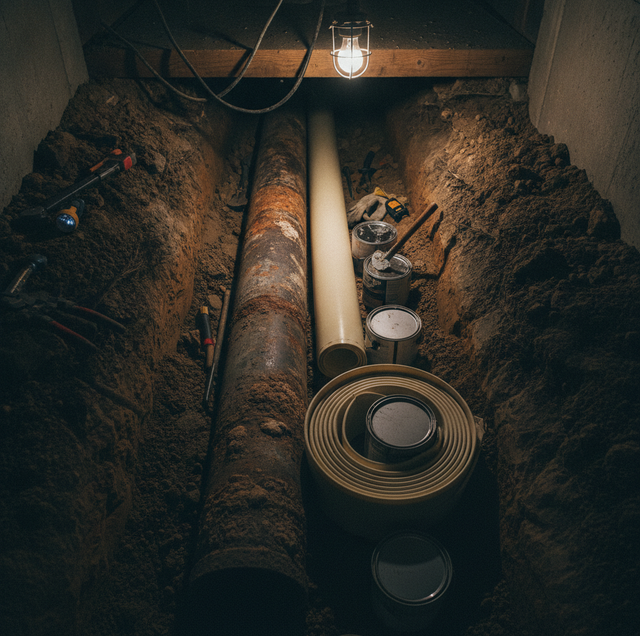
A failing sewer line used to mean one thing: a backhoe, a trench across your yard, and a torn-up driveway. Trenchless repair changed that, letting a damaged line be fixed with little or no digging. But once you go trenchless, there is a second decision to make, because the two main methods, cured-in-place pipe lining and pipe bursting, work in completely different ways and suit different pipes. Choosing the wrong one wastes the advantage.
The right method depends entirely on the condition of your pipe, so it helps to understand what each one actually does before you decide.
Two Trenchless Methods, Two Different Jobs
Both methods repair a sewer line without a full trench, but that is where the similarity ends. Cured-in-place pipe lining, or CIPP, rehabilitates your existing pipe from the inside. Pipe bursting replaces it entirely by pulling a new pipe through the old one. One renews what you have; the other swaps it out. That single difference between repairing the existing pipe and replacing it is the key to determining which one is right for a given situation.
Cured-in-Place Pipe Lining: A New Pipe Inside the Old
CIPP works by inserting a flexible liner coated in epoxy resin into your existing pipe, then curing it in place so it hardens into a smooth, continuous new pipe bonded inside the old one. The old pipe becomes the mold; the cured liner becomes the working pipe. It is ideal for pipes that are still structurally mostly intact but suffering from cracks, corrosion, scale buildup, leaks, or root intrusion at the joints, because it seals all of that from the inside and blocks roots from getting back in.
The trade-off is small but real: the liner adds a thin layer inside the pipe, slightly reducing the interior diameter. In a healthy-diameter pipe, that is a non-issue, and the smooth new surface often improves flow anyway. CIPP is the go-to when the existing pipe is a good enough host to line, which covers a large share of aging residential sewer problems.
Pipe Bursting: Out With the Old, In With the New
Pipe bursting is the heavier solution. A bursting head is pulled through the old pipe, breaking it apart and pushing the fragments out into the surrounding soil while simultaneously pulling a brand-new pipe into place behind it. You end up with a completely new pipe, not a lined old one. Because it replaces the pipe outright, it is the answer for pipes that are too far gone to line, collapsed, severely damaged, badly misaligned, or that have lost too much of their structure. It also has a standout advantage: since you are installing an entirely new pipe, often the result is very long-lasting, and bursting can even upsize the line to a larger diameter if you need more capacity.
The trade-off is that bursting is more invasive than lining. It requires access pits at each end to launch and receive the bursting head, so there is some digging, just far less than a full trench, and it needs room in the soil for the old pipe fragments to displace into.
| Factor | Cured-in-place lining (CIPP) | Pipe bursting |
|---|---|---|
| What it does | Coats and renews the existing pipe | Replaces the pipe entirely |
| Best for | Cracks, corrosion, roots, leaks; the pipe is mostly intact | Collapsed, severely damaged, or undersized pipe |
| Diameter | Slightly reduced by the liner | Same or can be upsized |
| Digging | Minimal, often just access points | Access pits at each end |
| Result | New pipe inside old, very durable | Brand-new pipe, very long-lasting |
How to Choose Between Them
The deciding factor is the condition of your pipe, as revealed by a camera inspection. If the pipe is structurally sound enough to serve as a host, cracked, corroded, scaled, leaking, or root-infiltrated but not collapsed, lining is usually the efficient, less invasive choice. If the pipe is collapsed, crushed, severely misaligned, or too deteriorated to line, or if you need to increase the pipe's capacity, bursting is the method that actually solves it. You do not really choose between them on preference; the pipe's condition chooses for you, which is why a proper inspection comes first.
Why the Local Ground Favors Trenchless
Trenchless methods are especially valuable where the soil is hard to dig. Caliche, a hard, cement-like layer found in many areas, makes traditional open-trench excavation slow, difficult, and destructive, so anything that avoids digging a long trench through it saves significant time, reduces costs, and minimizes damage to your yard and hardscape. That is exactly why lining and bursting are in such demand, where the ground fights a shovel: they reach the pipe with minimal digging. Between the two, the same rule applies: the pipe's condition decides. But the harder the ground is to dig, the more both trenchless options beat the old trench-and-replace approach.
Frequently Asked Questions
The mechanical difference shows up in how the resin sets and what it needs from the host pipe. CIPP saturates a felt or fiberglass liner with epoxy, inflates it against the pipe wall, and cures it one of three ways: ambient (left to set on its own, slowest), hot water or steam circulated through the liner, or an LED or UV light train pulled through it, which is the fastest and often finishes a residential lateral in an hour or two rather than several hours. Bursting has no cure step at all; it fractures the old pipe with a bursting head and tows a new HDPE pipe in behind it, so it works on lines a liner could never bond to.
Neither is universally better; it depends on your pipe's condition. Lining is ideal when the pipe is cracked, corroded, scaled, or root-infiltrated but still structurally serviceable. Bursting is the answer when the pipe is collapsed, severely damaged, or needs to be upsized. A camera inspection determines the situation you have, which decides the method.
Yes, typically on the order of an eighth of an inch of wall thickness, though the exact loss depends on the liner rating. Because the cured epoxy is far smoother than aged cast iron or clay, the Hazen-Williams flow coefficient of the new surface usually offsets the smaller bore, so real-world capacity often holds or improves on a standard four-inch residential lateral. The place it matters is a line already running near capacity or one you want to enlarge, and the lining cannot help because it can only work inward. Bursting is the opposite: it can pull in a pipe one nominal size larger, going from three to four inches, for example.
Yes, usually by one nominal size, because the bursting head displaces the old pipe fragments outward into the surrounding soil and makes room for a wider replacement. That upsizing has limits set by what is around the pipe: nearby utility lines, tree roots, shallow depth, or another pipe running close alongside can restrict how far the soil will yield, so the increase is not unlimited. It is also why a collapsed or badly offset pipe rules out lining and forces bursting; there is no continuous host bore left for a liner to bond to, so the line has to be broken out and replaced.
Mostly, but not entirely. Lining often requires only small access points, while bursting requires access pits at each end for the equipment, so both involve some digging. The point is that trenchless avoids the long, continuous trench of traditional replacement, which is what saves the yard, driveway, and time, especially in hard soil that is difficult to excavate.
A camera inspection tells you, but the pipe has to be cleaned first. Roots, grease, and hardened scale must be cut and hydro-jetted out before the camera can read the wall clearly and before any liner can ever bond, so cleaning is a prerequisite, not an add-on. The inspection also locates the pipe and its depth, which determines where access pits would be placed for bursting, and flags disqualifiers for lining, such as a collapse, a back-pitched or sagging section holding water, or a severe offset at a joint. Read those together, and the line's condition points to lining or bursting on its own.
Let the Pipe's Condition Decide
Cured-in-place lining and pipe bursting are both trenchless, but they solve different problems: lining renews a pipe that is damaged yet still serviceable, while bursting replaces one that is collapsed, severely deteriorated, or too small. The choice is not about preference but about the condition of your line, as revealed by a camera inspection. In hard, dig-resistant local soil, either trenchless method beats a full trench, and matching the right one to your pipe is what makes the repair last.
If you are facing a sewer repair and want to avoid tearing up your yard, we will inspect the line and recommend the right trenchless method. MNS Plumbing & Drain Cleaning serves Anthem and the Valley. ROC 262137. Call (602) 362-4524.
