
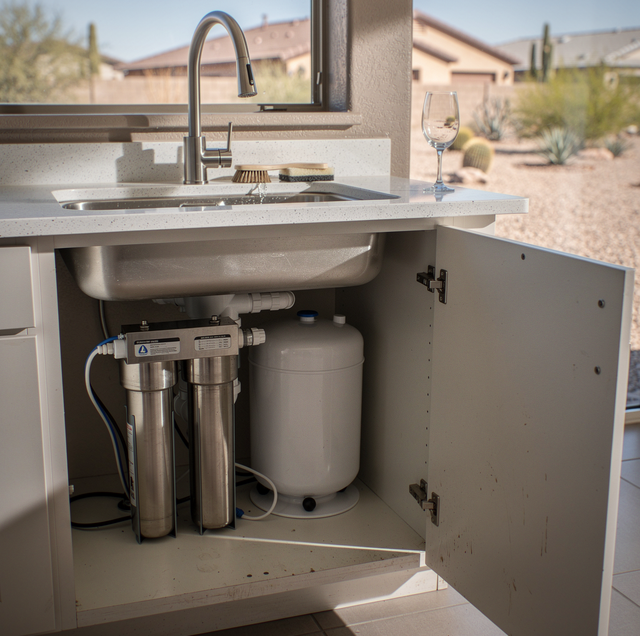
A water treatment decision comes down to one question: does the water need to be clean at every fixture in the house, or does it need to be as clean as possible at one faucet? A whole-house filter sits at the point where the home's water supply comes in and treats every gallon that passes through it, whether that gallon ends up in a shower, a washing machine, or a kitchen glass. A point-of-use reverse osmosis system, the kind installed under a kitchen sink, pushes a smaller volume of water through a membrane fine enough to strip out dissolved solids; a sediment-and-carbon whole-house filter leaves in place. Neither system does the other's job, and choosing between them starts with naming which job the household needs done.
| Where It Sits | What It Removes | Water It Treats | What It Wastes | Upkeep | |
|---|---|---|---|---|---|
| Whole-house filter | Main line, at the home's water supply entry | Sediment, chlorine or chloramine taste and odor, and in some builds a scale-conditioning stage | Every fixture and appliance in the house | Little to none, aside from a backwash cycle on media that regenerates | Cartridge or media replacement on a fixed schedule |
| Reverse osmosis | Under one sink, feeding a dedicated faucet | Dissolved solids, dissolved metals and minerals, and compounds a carbon-only filter passes through | Only the water drawn from its own faucet or a connected appliance line | A portion of the feed water, sent to the drain as reject | Prefilter and membrane changes |
What a Whole-House Filter Removes and What Passes Through
A whole-house filter is built in stages, and each stage is sized to handle the full flow of the home without slowing it down. A sediment stage catches suspended particles by size. A carbon stage adsorbs chlorine or chloramine and the organic compounds behind taste and odor complaints, using a large volume of carbon so the water gets enough contact time at full flow. Some systems add a conditioning stage aimed at the minerals that cause scale. That stage does not remove the minerals; it changes how they behave in solution, making them less likely to form a hard crust on a water heater element or a shower door.
All three stages work on particles, adsorbed compounds, or mineral behavior. None of them pull dissolved solids out of solution the way an ion-exchange or membrane process does, so a whole-house filter leaves the water's dissolved mineral and metal content close to where it started. That is by design: the goal is water safe and pleasant to bathe in, cook with, and run through appliances at full household volume, not water purified down to the ionic level.
How a Reverse Osmosis System Treats Water at the Tap
A reverse osmosis system pushes water through a membrane with pores small enough to block dissolved solids, dissolved metals, and compounds far smaller than sediment, while letting water molecules pass through. That kind of filtration only works well on water that has already had the coarse material removed, so a unit runs two or three prefilter stages ahead of the membrane: a sediment filter, then one or two carbon stages that strip chlorine before it can degrade the membrane surface. The membrane does the fine separation, but it needs those upstream stages to keep working.
Because the membrane cannot push all incoming water through its pores, part of the feed stream carries the rejected material straight to the drain rather than through the membrane. On a tank-style unit, what comes out the other side, the permeate, collects in a small pressurized storage tank rather than flowing straight to the faucet, because the membrane produces water too slowly to keep up with an open tap. Opening the RO faucet draws from that stored volume; the tank refills from the membrane in the background until it reaches capacity, then the system idles until the next draw. A final carbon stage, called a polishing filter, sits between the tank and the faucet to clear any taste the stored water picked up while sitting.
The drain line that carries reject water away from an RO unit should include an air gap fitting at the drain connection, which prevents wastewater from siphoning back into the membrane or the supply if the drain line clogs.
When Drinking and Cooking Water Is the Real Goal
Some households start this decision already knowing which fixture matters to them: the kitchen faucet, the refrigerator's water and ice line, or a pot filler used for cooking. If the concern is what ends up in a glass or a stockpot rather than what the water does to fixtures and appliances throughout the house, a point-of-use reverse osmosis system answers that question directly, because it treats only the water drawn from its own line.
That focus is also a limit. An RO system installed under the kitchen sink does nothing for the shower, the washing machine, or the water heater, because none of those fixtures pull from its line. A household that wants better-tasting drinking water but is not concerned with scale on fixtures, chlorine smell in the shower, or sediment reaching the washing machine can stop at the single tap and get what it asked for. One that starts asking about more than the kitchen faucet, staining on fixtures, a chlorine smell throughout the house, or sediment showing up in appliance filters is asking a whole-house question, and a single under-sink unit will not reach the fixtures that prompted the question in the first place.
When the Whole House Needs Treatment
A whole-house filter answers a different question: is the water doing something to the house itself, not just to what gets consumed? Chlorine or chloramine smell in every shower, sediment collecting in aerators and appliance inlet screens, or scale building on fixtures and inside a water heater are all whole-house symptoms, because they show up wherever water flows, not just at one tap. None of those get solved by treating a single faucet; the shower head, the washing machine, and the water heater never see water that only the kitchen's RO line has touched.
Point-of-entry treatment is also the only way to reach every fixture at once. Laundry, bathing, and dishwashing all run through fixtures a point-of-use system was never plumbed to reach, and a home with sediment or chlorine complaints across the board needs a stage that intercepts the water once, at the main line, rather than one that intercepts a fraction of it at a single tap. Where the same water also tastes or smells off at the kitchen faucet, a whole-house filter's carbon stage improves that as well, though it stops short of removing the dissolved solids an RO membrane targets.
Running Point-of-Entry and Point-of-Use Together
The two systems are not mutually exclusive, and plumbing them in sequence is one option, even though it means running two treatment stages instead of one. A whole-house filter installed ahead of an under-sink RO unit removes sediment and chlorine from the water before it ever reaches the RO prefilters, which means those prefilters load more slowly and the membrane sees water that has already had its chlorine stripped, rather than doing that job itself.
That sequencing also means the membrane's protection doesn't rest solely on the prefilters: sediment and chlorine are already out before the kitchen line branches off. A home running both gets the same everyday benefit at every fixture as a whole-house filter alone, plus the higher standard of treatment at the kitchen tap that only a membrane process provides. The tradeoff is two systems to maintain on two different schedules instead of one, which is a fair exchange for a household that wants both the whole-house symptoms handled and the drinking water treated past what carbon alone reaches.
Matching the System to What the Water Needs
The decision starts with naming the complaint rather than the equipment. A taste or odor complaint limited to drinking water calls for a point-of-use system. Scale, sediment, or chlorine smell showing up at more than one fixture calls for treatment at the main line. A household drawing from a private well carries an added layer: well water can carry dissolved metals, nitrates, or other contaminants that a carbon-based whole-house filter is not built to address, and treating that water only at the kitchen tap leaves every other fixture exposed to it; running both covers the dissolved metals and nitrates at the tap and the sediment everywhere else.
Sizing either system starts with the water's mineral and sediment load, because that load determines the media volume a whole-house filter needs and how hard an RO membrane has to work to keep up with household demand. Guessing at that load can leave a system undersized and shorten filter life. Installing either system also means cutting into the home's supply line, which is plumbing work rather than a fixture swap; doing it without shutting off the main and connecting properly risks a leak inside a cabinet or a wall.
Frequently Asked Questions
Only if it has an electric booster pump. A standard unit runs on line pressure alone; a booster pump added for low incoming pressure needs an outlet under the sink, while a permeate pump, which uses the reject stream's own pressure to push water into the tank, needs none.
It can, if the filter housing and media bed are sized only to the home's pipe diameter rather than its peak fixture demand. Sizing the filter to the number of fixtures likely to run at the same time, not just the line size, is what keeps pressure steady during simultaneous use.
Not on a standard install, which puts a separate, smaller faucet beside the kitchen faucet. Some kitchen faucets are built with a second waterway and lever for filtered water, so RO water can use a single spout without mixing with the unfiltered supply.
No. The prefilters intercept sediment and chlorine before that water reaches the membrane, so they load first and are replaced on a shorter cycle; the membrane sits behind that protection and goes on its own, with a longer replacement interval.
Not by itself. A standard sediment-and-carbon whole-house filter is not designed to remove bacteria or other microorganisms, so well water intended for drinking requires a separate disinfection stage, such as UV treatment, in addition to filtration.
Yes. The tank holds treated water under pressure against an internal air bladder, and that bladder's air charge can fade over years of use, which shows up as weaker flow or a tank that empties faster even though the membrane and filters are all current.
Reserve a water filtration installation — reverse osmosis, whole-house filtration, or both are sized and fitted to your household's demand and the fixtures that draw from it. MNS Plumbing & Drain Cleaning serves Anthem and the Valley. ROC 262137. Call (602) 362-4524.